


Advertising in Family Entertainment Centers
October 12, 2026
October 12, 2026 at 10:27 AM
Interactive attractions can offer more than entertainment. Discover how UTS AdMesh brings advertising to compatible play surfaces, connects visitors with offers through QR codes and measures ad delivery and response.

Beyond Entertainment: How Family Entertainment Centers Can Turn Interactive Attractions into Advertising Opportunities
Discover how UTS AdMesh helps family entertainment centers transform interactive attractions into advertising spaces, connect with relevant brands and measure campaign performance.
For family entertainment centers (FECs), interactive attractions are an important part of the visitor experience. They attract families, encourage participation and help create memorable activities for children and parents.
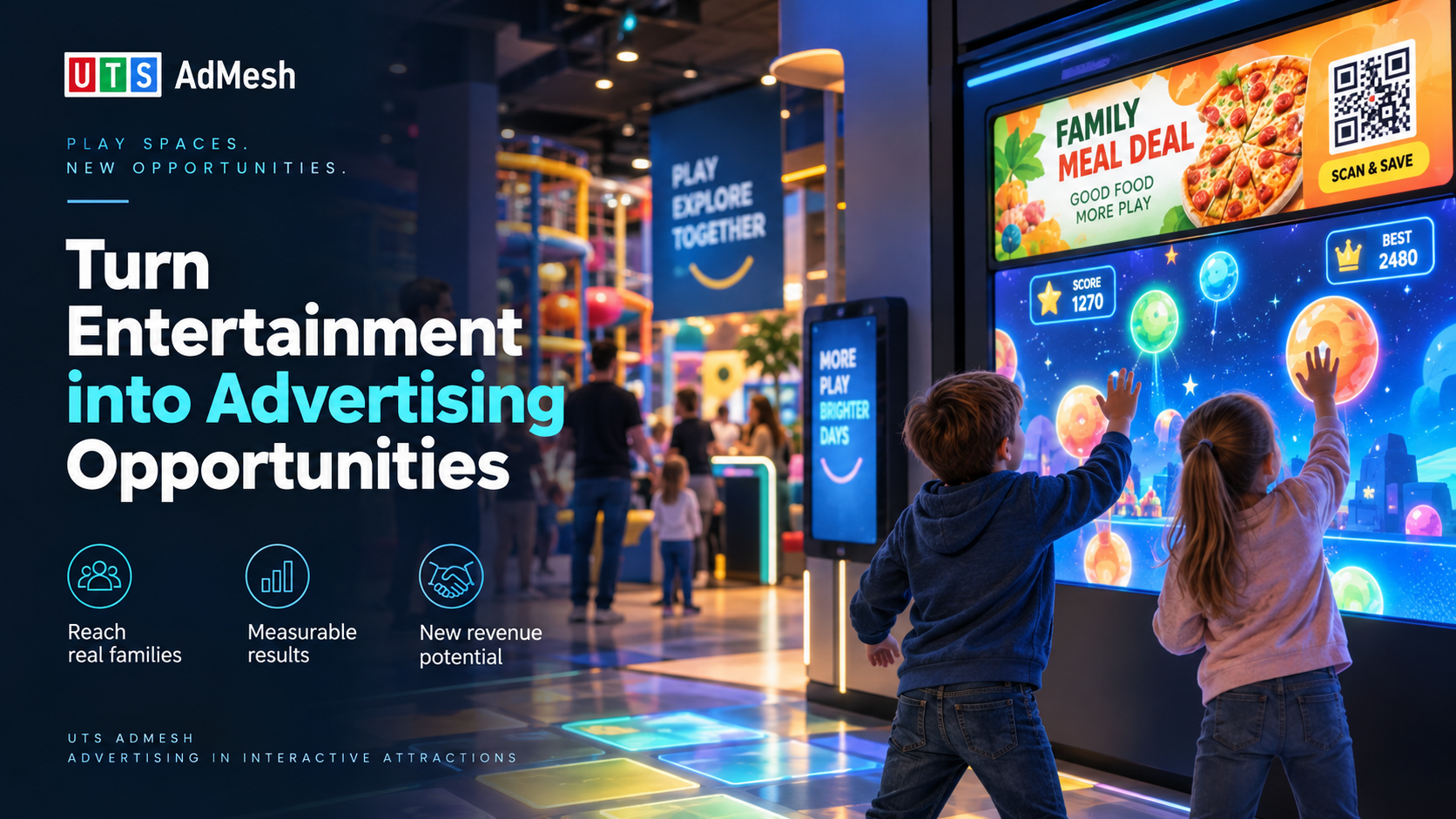
But interactive equipment can offer more than entertainment. The same screens and surfaces that visitors use for games can also become advertising spaces, creating opportunities for cooperation with local businesses, event organizers and consumer brands.
UTS AdMesh introduces a way to bring advertising into interactive entertainment environments, connecting advertisers with suitable venues and providing measurable campaign results.
Interactive Attractions as Advertising Spaces
Traditional advertising in entertainment centers often relies on posters, banners or digital signage. These formats occupy dedicated spaces and typically remain separate from the activities visitors come to enjoy.
Interactive attractions offer a different opportunity.
Throughout a visit, families encounter digital surfaces while choosing games, waiting for activities or reviewing their results. These moments can provide opportunities to display relevant advertising content.
UTS AdMesh supports advertising placements across different types of interactive installations, including:
Interactive walls: Large digital surfaces that can display advertising messages in supported applications.
Interactive floors: Play areas that may provide opportunities for promotional content.
Interactive tables and other surfaces: Digital installations that can incorporate advertising into compatible interfaces.
Available placements depend on the applications installed and their integration with AdMesh.
For entertainment center operators, this creates an opportunity to use existing interactive infrastructure for an additional commercial purpose.
Advertising That Fits the Family Entertainment Environment
Not every advertisement is appropriate for every entertainment venue.
A family entertainment center primarily welcomes children, parents and groups looking for shared activities. Advertising should therefore be relevant to the venue and its audience.
UTS AdMesh uses venue profiles to help match advertising campaigns with suitable locations.
A venue profile can include:
Country, region and city
Venue type, such as a family entertainment center
General audience age range
Audience categories and descriptive tags
The venue operator defines this information. The profile describes the audience without identifying individual visitors.
For example, a family entertainment center could be a suitable advertising environment for a nearby café, a family-oriented event or a brand promoting relevant products.
This approach helps connect advertisers with locations that fit their campaign objectives while allowing venue characteristics to guide campaign selection.
Four Opportunities to Display Advertising During a Visit
One of the advantages of advertising on interactive equipment is the possibility of using different moments in the visitor journey.
UTS AdMesh supports several placement types, depending on the application.
1. Idle Screens: Advertising Between Activities
When an interactive installation is not being used, its screen can display a full-screen advertising message.
For example, a nearby café could promote a special family offer to visitors who are waiting for their next activity.
This format can use images or videos and makes use of screen time between gaming sessions.
2. Game Menus: Sponsored Content During Game Selection
Visitors interact with game menus when deciding what to play next.
In compatible applications, AdMesh can introduce a sponsored tile alongside the available games.
The promotional tile is clearly identified as sponsored content. Visitors can open the offer and scan a QR code to learn more.
For example, a family event organizer could promote an upcoming weekend programme directly within the game selection interface.
3. During Gameplay: Advertising Within Compatible Games
Some interactive applications can provide dedicated advertising areas during gameplay.
The specific format depends on the game's design and technical integration.
This creates opportunities for advertising content to appear within supported game environments rather than exclusively before or after a session.
4. Results Screens: Offers After the Game
The end of a game provides another opportunity to communicate with visitors.
After completing an activity, players may see a promotional message or offer on the results screen.
For example, a local business could display a discount offer accompanied by a QR code.
This connects an advertising message with a natural transition point in the entertainment experience.
From Interactive Screens to Visitors' Smartphones
Advertising becomes more useful when visitors can respond to an offer.
UTS AdMesh supports QR-based advertising that connects the interactive installation with the visitor's smartphone.
The process is straightforward:
An advertisement appears on a supported interactive installation.
The visitor scans the QR code using their smartphone.
AdMesh records a request to the tracked advertising link.
The visitor is redirected to the advertiser's selected destination.
The destination might be a website, promotional landing page, product catalogue, event booking page or enquiry form.
For example, parents visiting an entertainment center might see an advertisement for a local family festival. By scanning the QR code, they can open the event programme and explore ticket options on their phones.
This creates a connection between advertising displayed at a physical entertainment venue and further interaction through a digital channel.
Advertising Opportunities for Local Businesses and Brands
Family entertainment centers are particularly interesting environments for businesses that want to communicate with families.
Several advertising scenarios can fit naturally into the visitor experience.
Local cafés and restaurants
A café near the entertainment center could promote a family meal offer. Visitors who scan the QR code can open the café's menu or promotional page.
Family events and activities
Organizers of children's festivals, workshops or weekend programmes could advertise upcoming events to families already interested in entertainment activities.
Consumer brands
Brands offering relevant products could use images or short videos to introduce their products, with QR codes linking to additional information or catalogues.
These examples illustrate how advertising can complement the venue visit while giving advertisers a way to reach audiences in a relevant physical environment.
Measuring Advertising Performance
For venue operators and advertising partners, campaign measurement is an important part of evaluating advertising opportunities.
UTS AdMesh provides reporting that connects advertising delivery with measurable visitor responses.
Three key metrics help describe campaign performance:
Impressions
An impression confirms that an advertisement was displayed by the device. It does not represent a unique individual viewer.
QR Visits
QR visits measure requests to the tracked redirect link associated with an advertisement.
Scan Rate
The scan rate shows the relationship between QR visits and impressions.
Scan Rate = QR Visits / Impressions × 100%
Together, these indicators help advertisers understand how frequently their content was displayed and how often visitors followed the QR link.
Importantly, a QR visit does not automatically represent a lead, booking or purchase. Those outcomes require additional measurement on the advertiser's side.
For entertainment center operators, campaign reporting provides a more transparent foundation for discussions with advertising partners.
An Additional Commercial Opportunity for FEC Operators
Interactive attractions are typically installed to provide entertainment, attract visitors and enhance the overall experience.
With an advertising solution such as AdMesh, compatible installations can also serve as advertising inventory.
This opens several potential business opportunities.
Additional revenue potential
Advertising placements create opportunities for entertainment centers to participate in commercial arrangements associated with their interactive equipment. Actual revenue opportunities and terms depend on the agreed commercial model.
Partnerships with local businesses
Entertainment centers can become relevant advertising locations for nearby cafés, family-oriented services, event organizers and brands.
More value from existing installations
Instead of treating interactive equipment exclusively as an entertainment asset, operators can explore additional uses for supported screens and digital surfaces.
Measurable advertising delivery
Campaign reporting makes it possible to evaluate advertising activity using confirmed impressions and tracked QR visits.
The central advantage is the possibility of introducing an additional commercial function into an environment that already attracts and engages visitors.
Getting Started with Advertising on Interactive Attractions
For entertainment center operators interested in AdMesh, the first step is to evaluate the venue's existing interactive equipment and available advertising placements.
The next consideration is the venue's audience profile, including its location, visitor characteristics and suitability for different types of campaigns.
Advertising campaigns can then be planned around relevant locations, creative formats and commercial objectives.
Campaign dates, placements, availability and commercial terms are agreed before launch.
As advertising activity develops, performance reporting can help identify which placements and creative approaches generate visitor responses.
Turning Play Spaces into New Business Opportunities
Family entertainment centers are evolving beyond traditional play environments. Interactive technology creates new ways to engage visitors, organize activities and develop relationships with commercial partners.
UTS AdMesh adds another possibility: using interactive attractions as advertising spaces that connect brands with relevant audiences.
For FEC operators, this means exploring additional commercial value from interactive installations while maintaining the entertainment environment that brings families to the venue.
Interested in exploring advertising opportunities with your interactive attractions?
Discover UTS AdMesh and learn how interactive entertainment spaces can become part of a measurable advertising network.