


AR Experiences for Museums and Science Centers
July 3, 2026
July 5, 2026 at 05:08 PM
Discover how AR experiences by UTS help museums and science centers turn exhibits into interactive learning spaces with sandbox, floor, and wall projections for children.

AR Experiences for Museums and Science Centers: Turning Exhibits into Interactive Discovery
Museums and science centers are no longer spaces where children only look, read, and move on. Young visitors expect to touch, explore, move, experiment, and see an immediate response to their actions. This is especially important for children’s museums, science centers, educational exhibition areas, aquariums, natural history museums, and interactive learning zones.
AR experiences by UTS help museums transform traditional exhibits into active discovery spaces. Instead of presenting information only through display cases, posters, or screens, museums can invite children to interact with digital environments projected onto sand, floors, and walls.
With UTS interactive technologies, children can build landscapes, explore volcanoes, uncover artefacts, bring drawings to life, play educational games, and take part in immersive workshops. For museums, this creates a more memorable visitor experience and helps connect learning with movement, creativity, and play.
What Is an AR Experience in a Museum?
An AR experience in a museum combines a physical environment with digital interactive content. Children interact with a real object or surface, while projected visuals respond to their actions in real time.
This can be a sandbox where mountains, rivers, volcanoes, and excavation zones appear on real sand. It can be an interactive floor where children step, move, and trigger animations. It can also be an interactive wall where drawings, colors, and digital characters become part of the exhibition.
The key value of AR for museums is simple: children do not just observe the exhibit. They participate in it.
For science centers and children’s museums, this format is especially effective because it supports hands-on learning. Children can test, compare, build, destroy, rebuild, and immediately see how the digital environment changes.
iSandBOX: Interactive Sandbox Exhibits for Museums
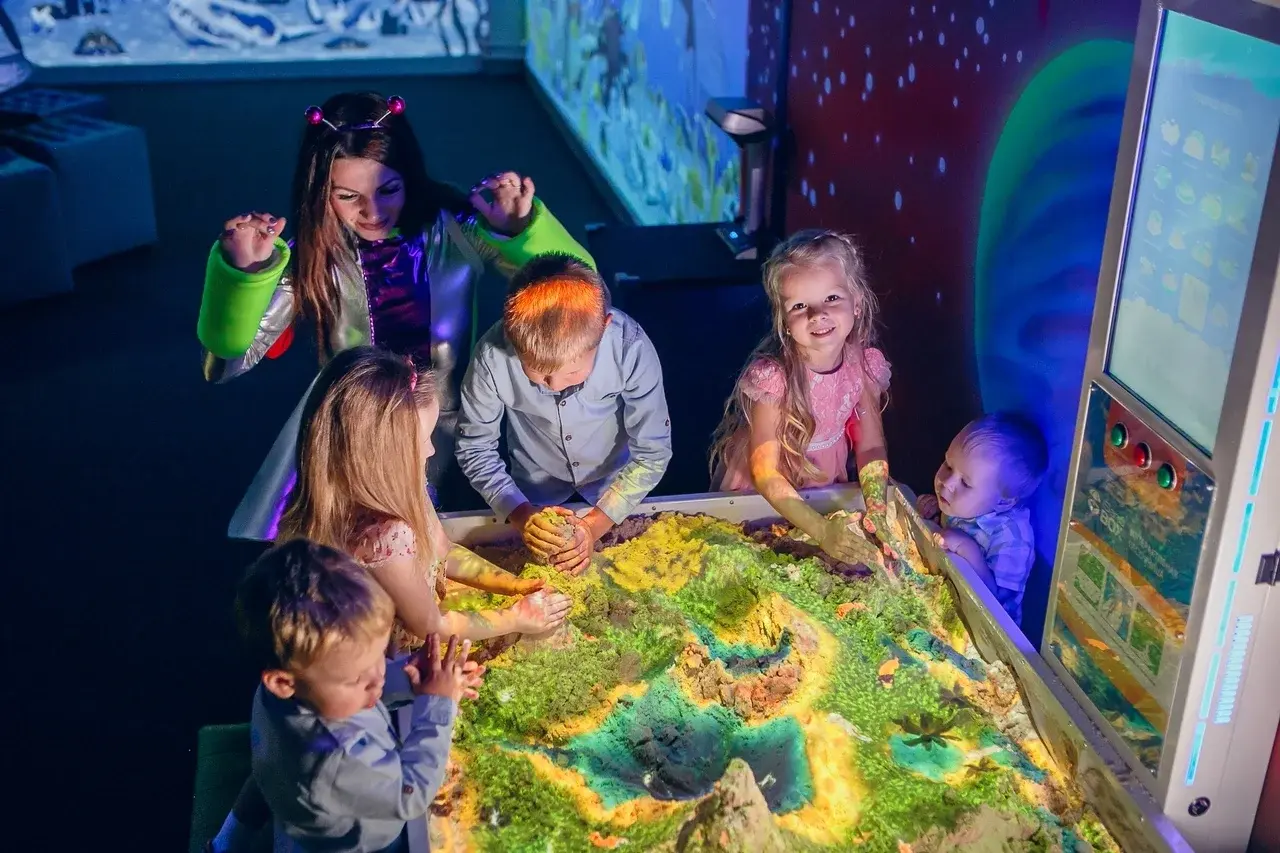
iSandBOX is one of the main UTS solutions for museums and science centers. It turns a physical sandbox into an augmented reality learning environment. The system projects animated digital content directly onto the sand, while sensors detect changes in the sand relief.
Children can shape mountains, valleys, rivers, islands, lakes, and volcanoes with their hands. As they change the landscape, the projection changes too. This makes abstract topics easier to understand because children can physically create what they are learning about.
For museums, iSandBOX can be used for:
Geography and topography activities, where children build landforms and observe how elevation affects the environment.
Volcano and natural disaster demonstrations, where visitors see how eruptions, lava, and landscape changes work.
Natural science workshops, where children explore water systems, ecosystems, and terrain formation.
Educational quests and treasure hunts, where children follow clues, dig, and interact with the sandbox environment.
Interactive lessons for preschool and school-age visitors, where museum educators use the sandbox as a visual and tactile teaching tool.
iSandBOX works well as both a permanent exhibit and a workshop station. It can attract children immediately, but it can also support structured educational sessions led by museum staff.
Custom Artefacts: Bringing Museum Collections Into AR
One of the strongest opportunities for museums is the ability to create custom AR content based on their own collections. With UTS Custom Artefacts, a museum can send photos of objects, artefacts, fossils, or exhibition items, and UTS can create a custom interactive mode featuring them.
This means children can uncover digital versions of real museum objects inside the sandbox. Instead of simply viewing an artefact behind glass, they can discover it through an interactive excavation activity.
This format is especially useful for:
Natural history museums with fossils, bones, shells, minerals, or prehistoric objects.
Archaeological museums with historical artefacts, tools, fragments, and cultural objects.
Aquariums and marine science centers with sea creatures, underwater treasures, and ocean-themed exhibits.
Local history museums that want to turn regional heritage into a children’s discovery activity.
Temporary exhibitions that need a unique interactive element for families and school groups.
Custom AR content makes the museum experience more personal. The activity is not generic. It is connected to the museum’s own collection, story, and educational goals.
Floorium: Interactive Floor for Museum Learning Areas
Floorium turns an ordinary flat floor into an interactive projection space. Children move across the projected surface, and the content responds to their movement.
For museums and science centers, Floorium is useful in areas where children need space to move, play, and learn together. It can be installed in children’s zones, entrance areas, educational rooms, family corners, waiting zones, or temporary interactive installations.
An interactive floor can support:
Movement-based learning games.
Group activities for children.
Attention and reaction exercises.
Themed museum routes and quests.
Immersive visual zones connected to the exhibition topic.
Floorium is especially valuable because it uses a surface that already exists in the building. A standard floor can become a digital playground, a science game, a nature-themed journey, or a dynamic learning environment.
This helps museums add interactive content without completely rebuilding the exhibition space.
Magic Wall 3-in-1: Interactive Wall Experiences for Museums
Magic Wall 3-in-1 by UTS brings interactivity to wall projections. It includes creative and educational formats that are well suited for museums, science centers, children’s areas, and learning spaces.
One of the most engaging formats is Living Drawings. Children color contour pictures, scan them, and see their drawings appear as animated characters on the wall. This connects creativity with technology and gives children a visible result of their work.
Another format, Paints and Brushes, allows children to interact with projected images using soft brushes and touch-based actions. It turns the wall into a large digital canvas.
For museums, interactive wall projections can be used for:
Creative workshops.
Themed drawing activities.
Educational storytelling.
Exhibition-related art stations.
Group activities for children and families.
This format works especially well when museums want to combine art, play, and learning in one area.
Why AR Works for Children’s Museums and Science Centers
AR experiences match the way children naturally learn. They support movement, experimentation, visual perception, and hands-on discovery.
For museums, this brings several practical benefits.
First, AR helps make learning more active. Children can interact with scientific, historical, or natural topics instead of only reading about them.
Second, AR broadens audience appeal. Interactive exhibits are attractive not only to children, but also to parents, teachers, school groups, and family visitors.
Third, AR can increase visitor dwell time. When children are involved in an activity, they spend more time in the exhibition area and engage more deeply with the topic.
Fourth, AR lowers the entry barrier for complex subjects. Topics such as topography, natural processes, archaeology, ecosystems, or cultural heritage become easier to understand when children can see and manipulate them directly.
Finally, AR creates experiences that visitors remember. A child may forget a label on a wall, but they are more likely to remember the moment they built a volcano, discovered an artefact, or saw their drawing come alive.
How Museums Can Use UTS AR Experiences
UTS solutions can be adapted to different museum formats and educational goals.
A science center can use iSandBOX for geology, geography, environmental science, and natural processes.
A children’s museum can use Floorium and Magic Wall to create movement-based and creative learning zones.
A natural history museum can use custom artefacts to build excavation activities around fossils, bones, minerals, or animal-related exhibits.
An aquarium can create underwater discovery games with marine creatures and ocean-themed content.
A local history museum can turn regional artefacts into interactive quests for families and school groups.
A temporary exhibition can use AR as a central engagement point that attracts children and makes the topic easier to understand.
Why Choose UTS for Museum AR Experiences
UTS develops interactive technologies specifically for education, entertainment, museums, and children’s spaces. The company offers a range of products that can work as separate exhibits or as part of a larger interactive museum zone.
UTS solutions include iSandBOX, Floorium, Magic Wall 3-in-1, Living Drawings, and custom interactive modes. The company also supports custom projects, localization, remote technical support, and global delivery.
For museums, this means they can choose not only a ready-made device, but also an AR experience adapted to their audience, exhibition theme, and educational program.
Turn Museum Visits Into Interactive Learning
AR experiences help museums and science centers move from passive observation to active discovery. They make exhibitions more engaging for children, more flexible for educators, and more memorable for families.
With UTS interactive sandbox, floor, and wall technologies, museums can create learning spaces where children build, move, explore, draw, dig, and discover.
Instead of only looking at an exhibit, children become part of it.
Create an interactive AR experience for your museum or science center with UTS.