


How to Explain Complex Phenomena Through Play: Making Landforms and Water Systems Visible with iSandBOX
September 16, 2026
September 28, 2026 at 06:41 AM
Discover how iSandBOX helps science museums explain landforms, water systems and other complex natural phenomena through interactive play and hands-on experiments.

How to Explain Complex Phenomena Through Play: Making Landforms and Water Systems Visible with iSandBOX
Explaining how landscapes form or how water moves across the Earth’s surface can be challenging — especially when the audience is children.
Terms such as watershed, elevation, valley, drainage basin or water flow describe processes that are difficult to understand from words and diagrams alone. A child may see a picture of a mountain and a river, but understanding how one affects the other requires something more: the opportunity to observe the relationship in action.
This is where interactive experiences can complement traditional museum explanations. With iSandBOX by UTS, children can build landscapes with their own hands and immediately see how changes in terrain affect water systems.
Instead of simply hearing how a process works, visitors can create the conditions, change them and observe the result.
From an Abstract Concept to a Visible Process
Many natural phenomena are based on relationships between different elements.
Water flows from higher areas to lower ones. Valleys influence its direction. Ridges can divide water flows. Depressions collect water. Changes in elevation can completely transform the way a water system develops.
For adults, these relationships may seem intuitive. For children encountering them for the first time, however, they can remain abstract.
A traditional museum display might use a diagram, map, model or video to demonstrate these processes. Interactive technology adds another layer: the visitor can influence what happens.
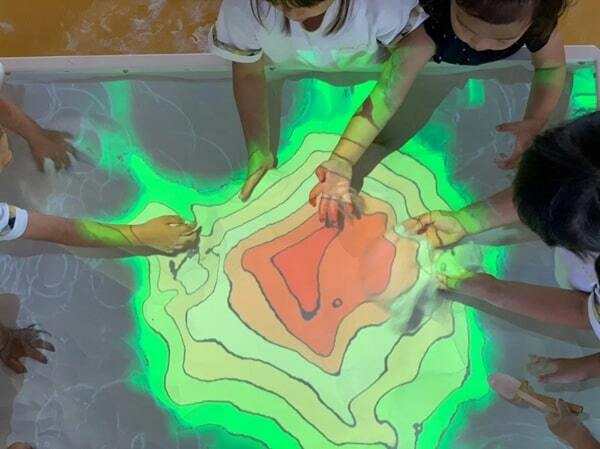
With iSandBOX, real sand becomes a dynamic landscape. Children can create mountains, valleys, plains and depressions, while projection and sensing technology visualize elevation and other effects directly on the sand surface.
The result is not simply a model to look at. It is a model that can be changed.
What Happens If We Change the Landscape?
One of the simplest ways to introduce scientific thinking is through a question:
“What do you think will happen if we change this?”
Imagine a museum educator discussing how water moves through a landscape. Instead of showing visitors the final answer immediately, the educator can invite them to create their own terrain.
Children can build a mountain, form a valley or create a depression in the sand. They can then observe how simulated water interacts with the landscape.
What happens if the mountain becomes higher?
Where does the water go if we create a new valley?
Can we redirect the flow?
What happens when we block its existing path?
Where will water accumulate?
Each physical change becomes a small experiment.
The important part is not simply finding the “correct” landscape. It is seeing the relationship between an action and its consequence.
Understanding Relief Through Touch
Topographic maps are an important tool for understanding landscapes, but interpreting them requires the ability to translate a two-dimensional representation into a three-dimensional mental model.
An interactive sandbox can help bridge this gap.
Visitors physically create differences in elevation. A high point is no longer just a color or line on a map — it is something they have built with their hands. A valley becomes a space between higher areas. A depression can be created, removed and reshaped.
This combination of tactile and visual information makes it easier to connect concepts such as:
elevation and relief;
mountains, hills and valleys;
slopes and depressions;
water movement across terrain;
accumulation of water in low areas;
relationships between landforms and water systems.
For younger visitors, these ideas can be introduced through simple observation. Older children can explore the same installation through more structured experiments and scientific questions.
Turning Water Systems into an Experiment
Water systems provide a particularly useful example because they demonstrate cause and effect very clearly.
Instead of presenting a river as a fixed blue line on a map, an educator can show that its path is connected to the surrounding terrain.
A museum activity might begin with a simple landscape. Visitors observe where water moves and where it collects. Then the educator asks the group to modify one part of the terrain.
Build a ridge. Create another valley. Raise one side of the landscape. Make a depression deeper.
The group can then observe whether the water behaves as expected.
This creates a natural sequence:
predict → change → observe → discuss.
Children are no longer only receiving information from the exhibit. They are forming a hypothesis and testing it.
One Exhibit, Different Levels of Explanation
A challenge for children’s museums and science centers is the diversity of their visitors. The same exhibit may be used by a five-year-old, a school group and an older child with a much stronger understanding of geography.
Interactive landscapes can support different levels of engagement without changing the basic installation.
For younger children, an educator might ask:
“Can you make a mountain?”
“Where do you think the water will go?”
“Can you create a lake?”
For older visitors, the discussion can become more detailed:
“How does elevation affect the direction of water flow?”
“What happens when a ridge separates two areas?”
“Can you redesign the terrain so that water flows in another direction?”
The physical activity remains accessible, while the scientific interpretation can become progressively more complex.
From Demonstration to Participation
For science museums, interactivity is most valuable when it does more than attract attention.
Pressing a button and watching an animation is interactive in a technical sense, but the visitor still has limited influence over the experience.
With a physical interactive environment such as iSandBOX, the visitor becomes part of the process. The landscape is not predetermined. Children create it themselves, and their decisions affect what they see next.
This creates an important shift:
The exhibit does not only demonstrate a phenomenon — it gives visitors a way to investigate it.
The educator’s role changes as well. Instead of explaining every process first, they can begin with a question, allow children to experiment and then help them interpret what happened.
Connecting Play and Scientific Thinking
To a child, building mountains in sand and redirecting water feels like play.
From an educational perspective, however, the same activity can introduce several elements of scientific thinking.
Children observe a system, make predictions, change one of its elements, compare the result with their expectations and discuss why the change occurred.
They also discover that natural systems are interconnected. Changing one part of a landscape can affect another part of the system.
This is difficult to communicate through definitions alone. It becomes much clearer when visitors can see the consequences immediately.
A More Tangible Way to Explain the Natural World
Science museums and educational centers often need to explain phenomena that are too large, slow or complex to observe directly.
Visitors cannot reshape a real mountain or redirect a river to see what happens. But they can explore simplified models that reveal the relationships behind these processes.
iSandBOX creates an environment where physical interaction, visualization and explanation work together.
A story about relief becomes a landscape visitors can reshape.
A discussion about water systems becomes an experiment.
And a complex natural process becomes something children can explore with their own hands.
For museums and science centers, this creates an opportunity to move beyond showing visitors what happens and invite them to discover why it happens.
Explore iSandBOX by UTS and discover how interactive landscapes can become part of your museum’s educational experience.