


Family Visits to Science Museums: Interactive Activities for Children and Parents
October 8, 2026
October 11, 2026 at 09:46 AM
Discover interactive activities for children and parents in science museums. Explore family challenges, hands-on experiments and shared learning with UTS Play.

Family Visits to Science Museums: Interactive Activities for Children and Parents
Discover how science museums and children's learning centers can encourage families to explore together through interactive exhibits, shared experiments and simple questions that turn play into discovery.
A family visit to a science museum is more than an opportunity for children to discover something new. It is also a chance for parents and children to explore, experiment and learn together.
However, creating an engaging experience for different generations can be challenging. Children often want to touch, move and experiment immediately, while adults may prefer to observe, explain or guide the activity.
Interactive exhibits can bring these approaches together. When an exhibit encourages visitors to change something, observe the result and discuss what happened, both children and adults can become active participants.
For science museums and children's discovery centers, the goal is not simply to keep everyone entertained. It is to create opportunities for shared exploration, meaningful conversations and memorable family experiences.
Why Family Participation Matters in Interactive Museums
In many traditional museum settings, adults take on the role of guides. They read descriptions, explain unfamiliar concepts and help children understand what they see.
Interactive exhibits create a different dynamic.
Instead of explaining everything in advance, parents can explore alongside their children. They can ask questions, suggest experiments and discover unexpected results together.
This approach offers several benefits:
More active participation. Parents become involved in the experience rather than simply watching their children play.
Natural learning opportunities. Scientific concepts emerge through experimentation and conversation.
Activities for different ages. Younger children can focus on physical interaction, while older children and adults explore causes and consequences.
Shared discoveries. Families create experiences they can discuss and remember after leaving the museum.
An effective family-oriented exhibit should make it easy for visitors to start experimenting without requiring extensive instructions or specialist knowledge.
Activity 1: Build a Landscape Together
One way to encourage family participation is to give visitors a shared creative challenge.
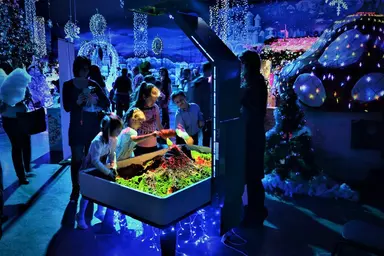
For example, at an interactive sandbox such as iSandBOX by UTS Play, children and parents can work together to create a landscape using real sand.
The system combines physical sand with augmented reality technology, displaying elevation colors and simulated water effects as visitors reshape the surface.
A museum facilitator might suggest a simple challenge:
"Can your family create a mountain, a valley and a river?"
Children can build hills and valleys with their hands, while parents help plan the landscape and discuss its features.
Once the landscape is ready, the family can explore questions such as:
Where is the highest point of our landscape?
What happens when we make a mountain taller?
Where will the water flow?
Can we create a valley between two mountains?
How can we change the landscape to redirect the water?
The activity combines physical creativity with observation and discussion.
Younger children may enjoy shaping the sand and watching the projected colors change. Older children can investigate how elevation influences water movement and how different landforms are connected.
Parents support the process by asking questions rather than providing immediate answers.
Activity 2: Make a Prediction and Test It
Scientific thinking often begins with a simple question: "What do you think will happen?"
Interactive exhibits are particularly suitable for activities that involve predictions and experiments.
Using iSandBOX, a family can create a small mountain landscape and investigate how water moves across different surfaces.
The activity can follow four simple steps:
Step 1: Make a prediction
A parent asks: "If we create a valley here, where do you think the water will go?"
Step 2: Change the environment
The child reshapes the sand to create the valley.
Step 3: Observe the result
Together, they watch how the simulated water responds to the landscape.
Step 4: Discuss the discovery
The parent asks: "Did the water go where you expected? What could we change next?"
This simple structure encourages children to think about cause and effect.
It also gives adults a clear role in the activity without turning the experience into a formal lesson.
The same approach can be adapted to other interactive museum exhibits involving movement, light, sound or physical forces.
Activity 3: Solve a Challenge as a Family Team
Not every museum activity needs to be an individual experiment. Some of the most engaging experiences involve solving a problem together.
For example, a science museum could introduce a challenge:
"A village is located near a river. Can your family create a landscape that keeps the village safe from rising water?"
Using an interactive sandbox, family members can build hills, valleys and channels, then explore how simulated water behaves.
Different participants can take different roles:
A younger child builds mountains and riverbanks.
An older child suggests where to create channels.
A parent asks questions and helps compare possible solutions.
The family can test several ideas, observe the results and adjust the landscape.
The purpose is not necessarily to find one perfect solution. It is to encourage cooperation, experimentation and discussion.
For museums, these activities offer an opportunity to connect scientific concepts with familiar real-world situations, such as floods, rivers and the relationship between natural landscapes and human settlements.
Activity 4: Switch Roles — Let the Child Become the Guide
Parents often explain things to children during museum visits. Reversing these roles can make the experience more engaging.
After exploring an interactive exhibit, invite the child to become the family’s scientific guide.
For example, the child can demonstrate how to build a mountain in iSandBOX, explain what happens when the sand is reshaped and show how the projected landscape changes.
Parents can act as curious visitors and ask questions:
Why did you build the mountain here?
Can you show me how to make a lake?
What happens if we remove this hill?
How would you explain this to someone visiting the museum for the first time?
This approach encourages children to describe their observations and organize their ideas.
It also allows parents to see what their children have understood through experimentation.
For younger visitors, explanations may be simple and visual. Older children can provide more detailed descriptions of landforms, elevation and water movement.
The important element is that the child becomes an active contributor to the family’s learning experience.
Activity 5: Create a Family Discovery Mission
Science museums can also connect individual exhibits through a series of small family challenges.
Instead of asking visitors to explore each exhibit independently, the museum can introduce a Family Discovery Mission.
Each family receives a set of questions or tasks to complete during its visit.
For example:
Mission 1: Discover
Find an exhibit where you can change something and observe the result.
Mission 2: Predict
Before starting an experiment, agree on what you think will happen.
Mission 3: Experiment
Change one element and observe how the outcome changes.
Mission 4: Explain
Ask one family member to explain the discovery to everyone else.
Mission 5: Explore Again
Try a different approach and compare the results.
At an iSandBOX station, these missions could involve creating different landscapes, experimenting with water movement or comparing the effects of high and low terrain.
Other exhibits can contribute different types of challenges.
The result is a more connected museum experience in which families actively investigate rather than simply move from one display to another.
How Museums Can Encourage Parents to Participate
Even a well-designed interactive exhibit may not automatically encourage adults to become involved.
Some parents may assume that an interactive installation is intended only for children. Others may be unsure how to participate without interrupting their child's exploration.
Museums can address this through simple activity design.
Use Questions Instead of Long Instructions
A short question can be more inviting than a detailed explanation.
For example:
"Can you make the water flow in a different direction?"
This immediately suggests an activity and encourages visitors to experiment.
Offer Challenges for Different Ages
A single exhibit can support several levels of participation.
For younger children, the task might involve creating a mountain or identifying colors.
For older children, it could involve comparing elevations, predicting water movement or solving a landscape-related problem.
Parents can help adapt the challenge to their child's abilities.
Encourage Cooperation Rather Than Competition
Family activities do not always need winners or scores.
Shared construction, experimentation and problem-solving allow participants of different ages to contribute without competing against one another.
Make Participation Easy to Start
A family should be able to understand the basic activity within a few moments.
Clear visual prompts, short questions and accessible physical interactions help reduce the need for constant staff assistance.
Museum facilitators can introduce more complex challenges when visitors show interest.
Turning an Interactive Exhibit into a Shared Learning Experience
For children's museums and science centers, interactive equipment is most valuable when it supports more than a single action or visual effect.
An exhibit becomes a learning environment when visitors can experiment, observe changes, ask questions and repeat the process.
iSandBOX by UTS Play illustrates this approach by combining hands-on landscape construction with responsive digital visualization.
Children can reshape real sand, while parents help them investigate what changes and why. The same installation can support free exploration, guided experiments, cooperative challenges and family discovery activities.
This flexibility allows museums to develop different educational scenarios around one exhibit, adapting them to visitors' ages, interests and learning objectives.
Making Family Visits More Meaningful
A successful family museum visit is not measured only by how many exhibits visitors see.
It is also about what families experience together.
When parents and children build something, test an idea or discover an unexpected result, the exhibit becomes a starting point for conversation and shared learning.
For science museums and children's discovery centers, designing activities around these moments can make interactive exhibitions more accessible and engaging for different generations.
With the right combination of hands-on interaction, simple challenges and open-ended questions, a museum visit can become a shared journey of exploration — one in which children and parents learn through discovery together.
Explore Interactive Learning with UTS Play
Discover how iSandBOX and other UTS Play interactive solutions can help science museums and children's learning centers create engaging hands-on experiences for family visitors.