


Floorium for Museums: Interactive Floor for Children’s Learning and Play
June 3, 2026
June 20, 2026 at 02:24 PM
Floorium by UTS turns an ordinary floor into an interactive play and learning space for children’s museums, science centers, aquariums, and educational exhibition areas.

Floorium for Museums: How Interactive Floors Turn Learning into Movement
Children’s museums and science centers need exhibits that do more than display information. Young visitors want to move, touch, react, play, and immediately see the result of their actions. For this audience, passive observation is often not enough.
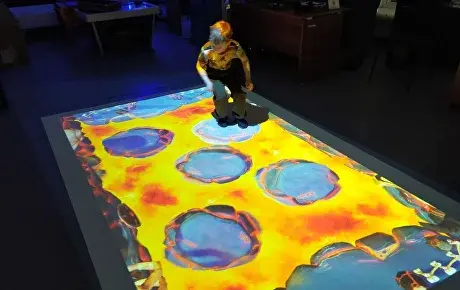
Floorium by UTS is an interactive floor system that turns an ordinary flat surface into a dynamic digital play and learning area. Animated content is projected onto the floor, while smart sensors detect children’s movements and make the projected environment respond in real time.
For museums, this means one important thing: the floor itself can become an exhibit.
What Is Floorium?
Floorium is an interactive projection system for entertainment, education, and physical activity. It projects animated game environments onto the floor and reacts to movement: steps, jumps, gestures, hand motion, squats, and other actions.
Instead of standing in front of a screen, children become part of the digital environment. They can run across a prehistoric field, avoid lava, interact with water, play football, explore underwater scenes, or take part in simple team-based challenges.
This format is easy for children to understand. They do not need long instructions. They step onto the floor, move, and the exhibit responds.
Why Floorium Works Well for Children’s Museums
Museums and science centers often face the same challenge: children move quickly from one exhibit to another unless the experience gives them something to do. Floorium helps create an active zone where visitors can stay longer, interact with each other, and connect movement with learning.
For children, the experience feels like a game. For museums, it becomes a flexible interactive exhibit that supports several goals at once:
It encourages physical activity and gross motor skills.
It supports focus, reaction, coordination, and decision-making.
It creates opportunities for collaborative play.
It adds a bright visual “wow effect” to the museum space.
It can be used as a permanent attraction, temporary activity zone, or part of an educational program.
How Museums Can Use Floorium
1. As an interactive science zone
Science centers can use Floorium to explain cause and effect, reaction time, coordination, movement, and spatial awareness. Children immediately see how their actions change the digital environment. This makes abstract concepts easier to understand through direct experience.
2. As a movement-based learning exhibit
Many museum visits are visually rich but physically passive. Floorium adds movement to the visitor journey. Children can jump, step, avoid obstacles, follow targets, and react to changing visuals. This is especially useful for younger visitors who learn better through physical engagement.
3. As a thematic play area
Floorium can support different museum themes. Dinosaur modes can fit natural history or paleontology areas. Sea battle and water-based games can work well in aquariums, marine museums, and science centers. Football and reaction games can be used for general activity zones or family programs.
4. As a waiting or transition area
Museums often have spaces where families wait before workshops, guided tours, birthday programs, or group sessions. Floorium can turn these waiting areas into meaningful engagement zones instead of empty space.
5. As a tool for group visits and school programs
For school groups, Floorium can be used to divide children into teams, create short challenges, or add movement breaks between educational activities. It gives educators and facilitators a simple way to keep children involved without requiring complex preparation.
Key Features for Museums
Floorium is designed for active public spaces. It includes a bright projection system, smart sensors, sound effects, and a large game area. The system can be managed from a tablet, where staff can select modes, configure settings, and start activities.
This is important for museums because the attraction should be easy to operate. Staff do not need to rebuild the space for every session. They can switch between games and adjust the experience depending on visitor age, group size, or activity format.
Floorium also supports strong visual quality. The 3D graphics help create an immersive environment that attracts attention from both children and adults.
More Than a Game
For museums, Floorium is not just a play product. It is a way to make the visitor experience more active, memorable, and accessible for children.
Children do not only look at content. They step into it.
They do not only read instructions. They discover how the environment reacts.
They do not only pass by an exhibit. They become part of it.
That is why interactive floors can be a strong addition to children’s museums, science centers, family educational spaces, aquariums, and edutainment zones.
Floorium by UTS for Modern Museum Spaces
Floorium helps museums create interactive zones that combine movement, play, learning, and visual impact. It can support educational programs, improve visitor engagement, and make museum experiences more dynamic for children.
For institutions looking to add more participation, more activity, and more memorable moments to their exhibitions, Floorium offers a practical way to turn an ordinary floor into an interactive discovery space.