


From Observation to Experiment: Interactive Learning with iSandBOX
September 14, 2026
September 14, 2026 at 07:24 PM
Discover how iSandBOX helps children’s museums and science centers turn visitors into active explorers who reshape landscapes, test ideas and observe changes in real time.

From Observation to Experiment: How iSandBOX Turns Museum Visitors into Active Explorers
In a traditional museum exhibit, the visitor observes. They look at an object, read an explanation, watch a demonstration and move on.
Interactive science centers are built around a different idea: understanding becomes stronger when visitors can influence what they see.
For children, this difference is especially important. Instead of simply learning that mountains affect water flow or that valleys form between higher areas, they can create these features themselves, change them and immediately observe the result.
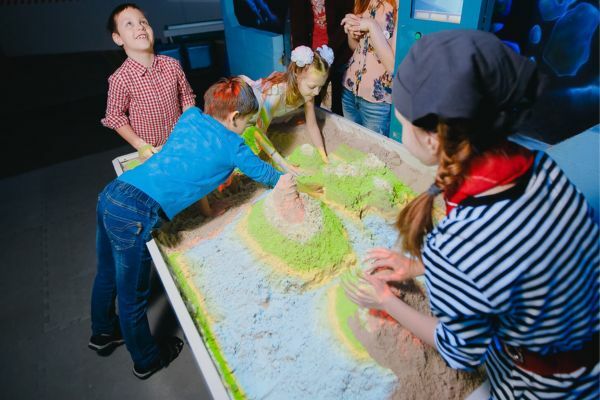
With iSandBOX by UTS, a physical sandbox becomes an interactive experimental environment. Children reshape real sand with their hands, while the digital projection responds to changes in the terrain in real time.
The visitor is no longer only watching an exhibit.
They become part of the experiment.
The Difference Between Showing a Process and Letting a Child Discover It
A museum can explain natural processes in many ways.
A diagram can show a river flowing through a valley. A video can demonstrate how water moves downhill. A model can show mountains, plains and lakes.
But there is another level of interaction: allowing the visitor to ask, “What happens if I change this?”
What happens if the mountain becomes higher?
What if a valley is created between two hills?
What if a channel is dug through the landscape?
What if one side of the terrain is raised?
What if the landscape is changed again?
With iSandBOX, children can test these ideas directly.
They build the terrain themselves and immediately see how the digital environment reacts. Mountains, valleys, lakes, shorelines and other landscape elements can change as the physical surface changes. In Topography mode, for example, the sandbox can visualize elevation and contour lines, helping visitors connect the shape of a three-dimensional landscape with its representation on a map.
Instead of receiving a ready-made answer, children discover relationships through their own actions.
A Simple Experimental Cycle
One of the most useful ways to integrate iSandBOX into a science center or children’s museum is to treat it as a small experimental station.
The process can be extremely simple:
Ask a question → change the landscape → observe the result → compare → change it again.
For example, a museum facilitator could ask:
“Where do you think the water will collect?”
A child creates several hills and depressions.
Then the landscape is activated and the result becomes visible.
Was the prediction correct?
Now the child can rebuild part of the terrain and run the experiment again.
This creates an intuitive introduction to scientific thinking. Visitors are not required to know scientific terminology before they begin. They start with curiosity, make a change and observe cause and effect.
Experiment 1: Build a Mountain and Change Its Shape
A simple mountain can become the starting point for several discoveries.
Children can first create one high peak and observe how the surrounding terrain appears.
Then they can make the mountain wider.
Or build two peaks.
Or flatten one side.
The facilitator can ask:
“Which slope is steeper?”
“Where would water move?”
“What happens when we make the mountain lower?”
“Can you create a valley between two mountains?”
The physical act of rebuilding the landscape makes the exhibit repeatable. There is no single correct final configuration. Every new shape creates another opportunity for observation.
Experiment 2: Create a Place for Water
Water behavior is particularly effective for demonstrating cause and effect because children can see how strongly the shape of the land influences what happens next.
In suitable iSandBOX scenarios, visitors can create depressions, channels and elevated areas and explore how water interacts with the terrain. Water Spring mode, for example, can be used to simulate mountain rivers, flooding and changes connected with water movement.
A facilitator might challenge visitors:
“Can you create a lake?”
“Can you make a river reach the other side?”
“What happens if we block its path?”
“Can you protect this area from water?”
The important part is not whether the child succeeds immediately.
The important part is that they can change the model and try again.
That turns interaction into experimentation.
Experiment 3: Build Two Different Landscapes
Another approach is comparison.
Children can divide the sandbox conceptually into two areas and create different types of terrain.
On one side, they might build steep mountains.
On the other, a low and relatively flat landscape.
Then they can compare what they see.
Which area has greater differences in elevation?
Where are valleys easier to identify?
How would water behave differently?
Which landscape would be easier to build a road through?
For older children, museum educators can gradually introduce concepts such as elevation, slope, drainage basin or contour lines. Younger visitors can work with simpler ideas such as high and low, mountain and valley, land and water.
The same installation can therefore support different levels of interpretation without changing the basic interaction.
The Exhibit Changes Because the Visitor Changes It
Static museum exhibits have a predefined appearance.
An interactive landscape does not.
One visitor may create an island surrounded by water. The next may destroy it and build a mountain range. Another child may dig channels through the same terrain.
As a result, visitors do not necessarily encounter exactly the same exhibit.
They create part of the experience themselves.
This is important for science centers because repeatability does not have to mean repetition. The basic principle remains the same, but the landscape, questions and results can be different each time.
A child who returns to the sandbox can conduct another experiment rather than simply repeat the previous interaction.
From “Press the Button” to Meaningful Interaction
Not every digital exhibit is truly interactive.
Sometimes interaction means pressing a button and watching a predefined animation. The visitor triggers the experience but does not substantially change it.
With a physical-digital installation such as iSandBOX, the visitor has more control over the conditions of the experiment.
The shape created with their hands becomes an input.
The system responds.
The visitor observes the response and decides what to change next.
This creates a continuous feedback loop between the child and the exhibit.
For museums and science centers, that makes the technology useful not only because it attracts attention, but because the interaction itself can carry educational meaning.
Free Exploration or a Facilitated Museum Activity
The same installation can support two different visitor experiences.
During open museum hours, children can approach iSandBOX independently and begin experimenting without a long introduction. Changing the sand and seeing the environment respond creates an intuitive entry point.
During workshops, school visits or scheduled science activities, museum educators can add specific challenges.
For example:
Build a landscape where water collects in one place.
Create the highest mountain you can.
Make two different valleys and compare them.
Create an island and then connect it to the mainland.
Change the terrain so that water takes a different route.
Build a landscape and ask another visitor to predict what will happen when it changes.
The equipment remains the same, while the questions transform it into different learning experiences.
Children Learn by Changing the Model
Some natural processes are difficult for children to understand because they happen on scales that cannot easily be observed.
Mountains form over enormous periods of time. Rivers reshape landscapes gradually. Maps turn three-dimensional terrain into symbols and lines.
An interactive model makes some of these relationships easier to explore.
A child does not have to imagine every stage.
They can create a landscape, observe it, modify one element and compare the new result with the previous one.
In this way, the exhibit introduces an important scientific principle: when conditions change, the result may change too.
And because children create those conditions themselves, the connection between action and result becomes much more visible.
A Museum Exhibit That Starts with a Question
The strongest interactive exhibits do not simply provide information.
They encourage visitors to ask another question.
What if I build it differently?
Why did the water go there?
What happens if I make this part higher?
Can I create a different result?
With iSandBOX, the landscape becomes something children can investigate rather than simply observe.
They touch it, reshape it, test an idea, see what happens and try again.
For children’s museums and science centers, this turns a sandbox into something more than an interactive display.
It becomes a small laboratory where every visitor can create their own experiment — and where discovery begins with their own hands.