


How Children Learn About Dinosaurs with UTS Interactive Devices
July 9, 2026
July 19, 2026 at 04:19 PM
Discover how UTS interactive sandboxes, floors, and walls help museums and science centers teach children about dinosaurs

How Children Can Learn More About Dinosaurs with UTS Interactive Devices
Dinosaurs are one of the most fascinating topics for young museum visitors. Children want to know what these prehistoric animals looked like, where they lived, what they ate, and why they disappeared.
Traditional dinosaur exhibitions usually answer these questions through skeletons, models, information panels, and videos. These elements remain important, but young visitors often need something more than observation. They want to move, touch, experiment, dig, and see an immediate response to their actions.
UTS interactive devices help museums, science centers, natural history exhibitions, and children’s discovery spaces turn dinosaur education into an active experience. Interactive sandboxes, floors, and walls can be used together to introduce prehistoric landscapes, paleontology, dinosaur behavior, extinction events, and the work of scientists.
From Looking at Dinosaurs to Exploring Their World
A child may look at a dinosaur skeleton for a few moments. However, when the child can search for fossils, create a prehistoric landscape, follow dinosaur footprints, or interact with a moving dinosaur, the subject becomes much easier to understand.
UTS devices transform visitors from observers into participants.
Instead of only reading that dinosaurs lived in different environments, children can build mountains, rivers, islands, and valleys. Instead of simply looking at a fossil, they can take part in a simulated excavation. Instead of seeing a dinosaur image on a poster, they can interact with a responsive digital creature.
This approach supports learning through action, discovery, and play.
Discovering Dinosaurs with iSandBOX
iSandBOX combines physical sand with interactive projection technology. As children reshape the sand, the projected landscape changes in real time.
For a dinosaur-themed museum experience, children can create different types of prehistoric terrain, including hills, lowlands, rivers, lakes, and islands. This helps them understand that dinosaurs did not live in one universal environment. Different species depended on different landscapes, food sources, and natural conditions.
Children can also discover dinosaurs within the projected world and learn more about their appearance and behavior. Interactive events, such as a meteor shower or a tornado, can help educators introduce conversations about natural processes and environmental change.
One of the most engaging activities is simulated paleontological excavation. Children dig through the sand and uncover dinosaur skeletons hidden beneath the surface.
The activity can become the starting point for several questions:
What is a fossil?
How do scientists find dinosaur remains?
Why are skeletons sometimes incomplete?
How can researchers identify an animal from its bones?
What can fossils tell us about prehistoric life?
The physical process of digging makes paleontology more understandable. Children do not simply hear what paleontologists do. They perform a simplified version of the same process themselves.
Walking Through Prehistoric Environments with Floorium
Floorium transforms an ordinary floor into an interactive digital environment that responds to visitors’ movements.
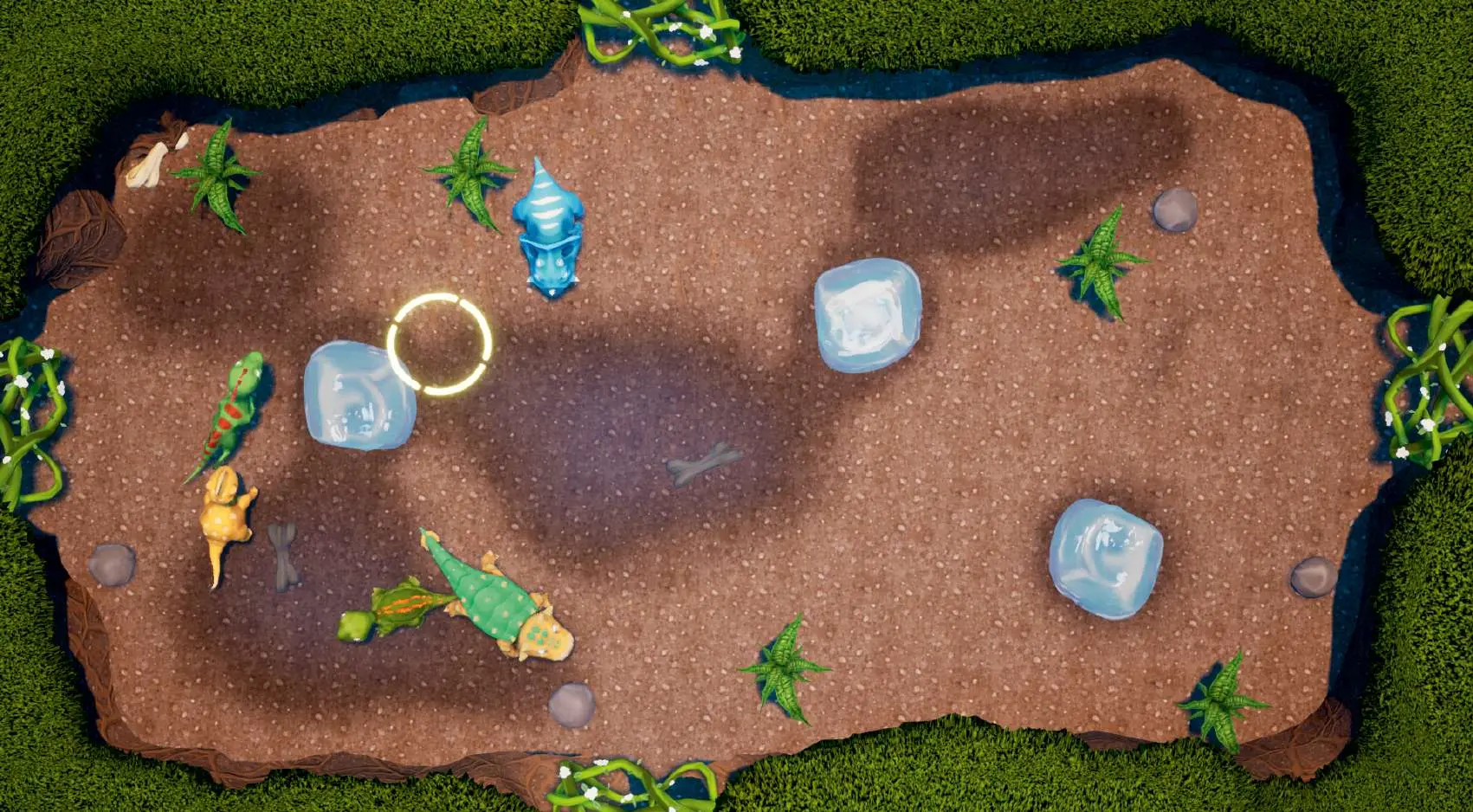
In a dinosaur exhibition, the interactive floor can extend the learning experience beyond display cases and information screens. Children can enter a prehistoric landscape, move through different environments, follow tracks, avoid obstacles, or participate in themed challenges.
Movement-based activities are particularly effective for younger visitors. Children may not be ready to study a long description of dinosaur behavior, but they can understand a task that asks them to follow footprints, find a safe route, or explore different areas of a projected landscape.
Floorium can also help museums demonstrate scale. Large projected creatures, footprints, plants, and environmental elements can give children a stronger impression of how different the prehistoric world was from the world they know today.
The floor therefore becomes more than an entertainment zone. It becomes an active part of the exhibition narrative.
Interacting with Dinosaurs on an Interactive Wall
A UTS interactive wall allows children to control projected content through touch and movement. It can be used as a responsive learning surface where dinosaurs, objects, facts, and animations react to visitors.
Museums can use the wall to introduce different species, compare their characteristics, and encourage children to observe important details.
For example, visitors can explore questions such as:
Which dinosaurs were herbivores?
Which species walked on two legs?
How did dinosaurs protect themselves?
Why did some dinosaurs have horns, plates, or long necks?
How were different species adapted to their environments?
The interactive format helps break complex information into short visual actions. A child can select a dinosaur, trigger an animation, see a visual response, and then receive an explanation from an educator or accompanying adult.
The wall can also support collaborative activities. Several children can explore the same environment, complete tasks together, and discuss what they observe.
Creating a Complete Dinosaur Learning Journey
The strongest museum experience can be created by connecting several UTS devices around one educational topic.
A dinosaur-themed visitor journey could begin with an interactive wall where children meet different species and learn their basic characteristics. They could then move to Floorium and enter a projected prehistoric environment. Finally, they could use iSandBOX to build landscapes and excavate dinosaur remains.
Each device presents the subject from a different perspective:
The interactive wall supports visual exploration and comparison.
Floorium adds movement and spatial experience.
iSandBOX provides construction, experimentation, and excavation.
Together, these installations help museums combine digital interaction with physical activity and hands-on discovery.
The same exhibition can therefore appeal to children with different learning preferences. Some visitors are interested in facts and images. Others prefer movement, construction, or exploration. A multi-device experience gives them several ways to engage with the same subject.
What Children Can Learn Through Interactive Dinosaur Experiences
Dinosaur-themed activities can support more than the memorization of species names.
Children can develop an understanding of paleontology, fossils, prehistoric ecosystems, food chains, environmental change, and scientific investigation. They can observe relationships between landscapes and living creatures, explore cause and effect, and compare different physical adaptations.
Interactive activities also support broader skills, including:
Observation and attention
Spatial thinking
Problem-solving
Motor coordination
Communication and teamwork
Curiosity and independent exploration
These skills are especially important in children’s museums and science centers, where learning is often based on experimentation rather than formal instruction.
Supporting Educator-Led Activities
UTS devices can be used for free visitor exploration as well as structured educational sessions.
Museum educators can prepare guided activities for school groups, families, workshops, and science programs. For example, children can receive a task to create a suitable habitat for a particular dinosaur, locate hidden remains, compare herbivores and predators, or discuss what may happen when an environment changes.
The same installation can support different levels of complexity. Younger children may focus on movement, digging, and visual discovery. Older children can discuss geological periods, species adaptation, extinction theories, and scientific research methods.
This flexibility allows museums to use interactive technology with visitors of different ages without rebuilding the entire exhibition.
Making Dinosaur Exhibitions More Memorable
Children often remember what they actively discovered better than what they only saw.
A large dinosaur skeleton may create an impressive first reaction. An interactive experience helps extend that reaction into a deeper learning process. Children can investigate the environment around the animal, search for evidence, test ideas, and connect new information with physical actions.
UTS interactive devices help museums create this transition from attention to participation.
By combining iSandBOX, Floorium, and interactive wall experiences, museums and science centers can turn the story of dinosaurs into a multidimensional journey. Children do not simply learn that prehistoric animals once existed. They explore how they lived, investigate what they left behind, and begin to understand how scientists reconstruct a world that disappeared millions of years ago.
Bring Prehistoric Discovery to Your Museum
UTS interactive solutions can complement permanent dinosaur exhibitions, temporary installations, educational laboratories, children’s zones, and natural history programs.
With responsive sand, floor, and wall projections, museums can create dinosaur experiences that encourage children to move, explore, experiment, and ask questions.
Contact UTS to learn how interactive devices can become part of your museum or science center’s dinosaur exhibition.