


How to Engage Children of Different Ages: Adapting Interactive Play for Every Visitor
October 8, 2026
October 9, 2026 at 07:10 AM
Discover how to adapt game scenarios, rules and difficulty levels for younger and older children in family entertainment centers.

How to Engage Children of Different Ages: Adapting Interactive Play for Every Visitor
A family entertainment center rarely works with just one age group. On the same day — and often at the same time — it may welcome preschoolers, primary school children and older kids. They have different abilities, interests and expectations, yet they all need to find something that feels engaging and appropriate for them.
This creates an important challenge for entertainment center operators: how can one play space remain interesting for children of different ages without creating a separate attraction for every group?
One solution is to build flexibility into the experience itself. By changing game scenarios, rules, difficulty levels and the way activities are organized, the same interactive equipment can support very different types of play.
Why Age Matters in Interactive Play
A game that immediately attracts a four-year-old may feel too simple for a ten-year-old. At the same time, an activity designed around speed, competition and complex rules can frustrate younger children before they have a chance to enjoy it.
The difference is not simply about making a game "easy" or "difficult." Children of different ages often respond to different types of motivation.
Younger children usually benefit from clear visual feedback, simple actions and immediate results. Touching, moving, throwing, drawing and seeing the environment react can be enough to keep them involved.
As children get older, they can handle more rules and longer sequences of actions. They may become more interested in completing missions, earning points, competing with others, improving previous results or working together toward a goal.
For an entertainment center, this means that the most versatile attraction is not necessarily the one with the largest number of games. It is the one that allows the same basic interaction to be turned into different experiences.
For Younger Children: Simple Actions and Immediate Feedback
With preschool-age children, the first goal is usually to make the connection between action and result easy to understand.
A child moves — something happens. A ball hits the wall — the image reacts. Sand is reshaped — the virtual landscape changes. A drawing is completed — it appears in an animated environment.
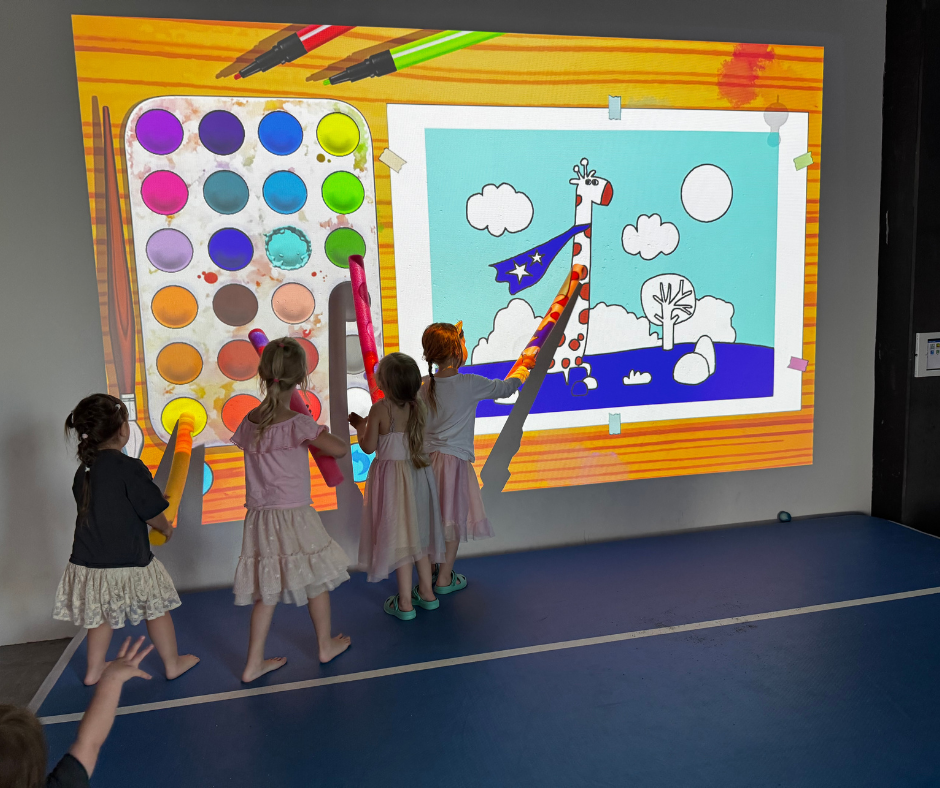
Interactive equipment such as iSandBOX, interactive walls and floors or Living Drawings can support this type of intuitive play. Children do not need to understand complicated instructions before they begin. They can explore the activity naturally and learn through interaction.
At this age, scenarios can focus on discovery rather than performance. Instead of asking who achieved the highest score, the activity might invite children to find objects, change an environment, follow simple visual prompts or experiment with different actions.
Short game cycles are also useful. A child can complete one activity quickly, see the result and decide whether to repeat it or move on.
For Primary School Children: Add Goals and Challenges
As children get older, the same interactive environment can introduce more structure.
Instead of simply interacting with objects on a screen or projection, children can be given a specific task: collect certain items, complete a sequence, reach a target score, solve a challenge within a time limit or cooperate with another player.
Competition can also become part of the experience.
Interactive wall games, ball games and other active scenarios can be organized around individual scores or teams. The basic physical interaction remains accessible, while the rules create an additional layer of challenge.
This is where adaptable solutions such as FlexPlay become particularly useful. A single interactive area can support different types of activities — from creative play and Living Drawings to active ball games and other interactive scenarios. Operators can change the experience depending on the age of the group, the number of children or the format of the visit.
For Older Children: Make the Experience More Competitive
Older children usually need more than colorful animation to stay interested. They want to understand what they are trying to achieve and whether they can do it better than someone else.
The activity can therefore become faster, more competitive and more strategic.
Instead of simply hitting interactive targets, players might need to achieve the highest score within a limited time. Instead of completing an individual task, they might compete in teams. Instead of following one simple objective, they might need to react to several elements at once.
Solutions designed around active gameplay, including interactive wall games, AstroBlaster, IceHook and different FlexPlay configurations, can support this type of experience.
The equipment itself does not necessarily need to change. What changes is the scenario around it: the rules, timing, scoring system, team structure and level of challenge.
One Attraction Can Have Several Difficulty Levels
Entertainment centers can also think about difficulty as a variable rather than a fixed property of a game.
For younger visitors, an interactive challenge might use larger targets, slower movement and more time to complete the task.
For older children, the same concept can use smaller or moving targets, shorter reaction times, additional rules or competitive scoring.
This approach allows an attraction to serve a wider audience without making younger children feel unsuccessful or older children feel that the game is "for little kids."
It also makes it easier for siblings and mixed-age groups to play in the same entertainment center.
Mixed-Age Groups Need Flexible Rules
Birthday parties and family visits often bring children of different ages together. Separating them into completely different activities is not always practical — and may not be desirable.
Instead, operators can adapt the rules.
For example, younger children can receive more time to complete a task, while older participants play against a timer. Teams can intentionally include children of different ages. Some activities can focus on points and competition, while others emphasize a shared result.
An interactive wall can first be used for a simple group game and later become the center of a tournament. An iSandBOX session can begin with free exploration for younger children and develop into a structured challenge for older participants.
The attraction remains the same, but the experience changes.
Change the Scenario Throughout the Day
Age adaptation can also become part of the daily operating model of an entertainment center.
During hours when younger children visit most frequently, a zone can offer calmer, exploratory and creative activities. Later in the day, the same space can switch to faster games, challenges and competitions for older children.
For birthday parties, operators can select activities according to the age of the group before the event begins.
This gives the entertainment center more flexibility without requiring every age segment to have its own dedicated area.
More Age Groups from the Same Play Space
For family entertainment centers, flexibility has a direct operational value.
If an attraction appeals only to a narrow age group, its potential audience is limited. If the same space can offer simple exploration for preschoolers, active games for primary school children and competitive challenges for older kids, it can serve a much broader range of visitors.
The key is not to make every game suitable for everyone in exactly the same way.
The better approach is to create different ways to experience the same interactive environment.
With adaptable scenarios, difficulty levels, rules and formats, UTS Play equipment can help entertainment centers turn one play zone into multiple experiences — giving younger children an accessible starting point while providing older children with enough challenge to keep them engaged.
Explore UTS Play interactive solutions and discover how one entertainment space can adapt to different ages, group formats and play scenarios.