


iSandBOX by UTS: How an Interactive AR Sandbox Turns Children’s Learning into Exploration
May 18, 2026
May 22, 2026 at 05:31 PM
Discover how iSandBOX by UTS helps children’s museums and science centers create interactive educational experiences with augmented reality, hands-on learning, and immersive play.

iSandBOX by UTS: How an Interactive AR Sandbox Turns Children’s Learning into Exploration
Modern children’s museums and science centers are no longer just places where visitors look at exhibits. Families expect experiences that are interactive, memorable, and educational at the same time. Children want to touch, build, move, experiment, and instantly see the result of their actions.
That is why interactive technologies are becoming an important part of museum and science center design. They help explain complex topics through play and turn passive observation into active discovery.
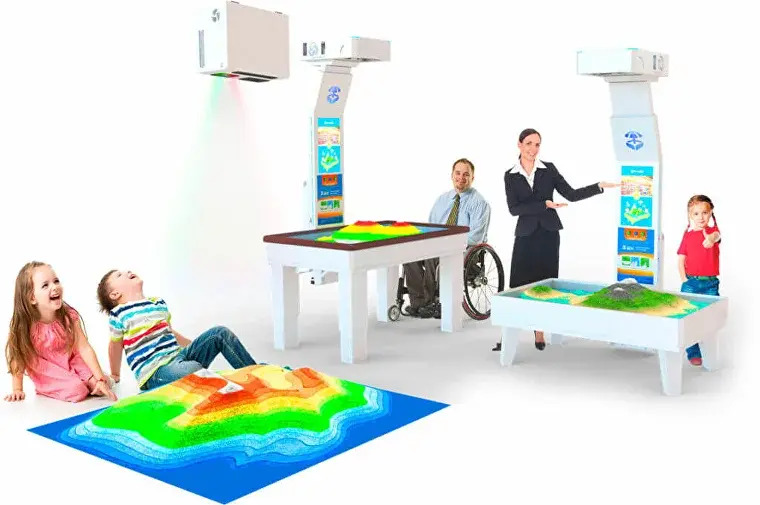
iSandBOX by UTS is one of these solutions. It is an augmented reality sandbox that transforms ordinary sand into a dynamic 3D learning environment. Children shape the sand with their hands, and the system instantly projects digital landscapes, colors, textures, objects, and game elements onto the surface.
For museums and science centers, iSandBOX can become more than just an attraction. It can be used as an educational exhibit, a creative play zone, a geography learning tool, a sensory experience, or a flexible interactive installation for children of different ages.
What Is iSandBOX?
iSandBOX is an interactive augmented reality sandbox designed for education, entertainment, therapy, exhibitions, and creative development.
The idea is simple and intuitive: children interact with real sand, while digital content reacts to every change in the landscape. When a child builds a mountain, digs a riverbed, creates a valley, or changes the height of the sand, the system recognizes these changes and updates the projection in real time.
The sandbox can visualize:
elevation and contour lines;
mountains, hills, rivers, lakes, and valleys;
animated environments;
interactive animals and objects;
educational scenarios;
creative and game-based modes.
This makes iSandBOX especially useful for children’s museums and science centers, where learning needs to be visual, hands-on, and emotionally engaging.
How iSandBOX Works
The system combines physical interaction with digital projection.
A depth sensor captures a 3D height map of the sand surface in real time. This data is transferred to the computer, where it is processed by the software. Then the projector updates the image on the sand surface according to the shape created by the child.
As a result, the sandbox becomes a living landscape. Blue water can appear in lower areas, green hills can rise on elevated surfaces, contour lines can show the structure of the terrain, and interactive objects can react to movement and changes in the sand.
This creates a direct connection between action and result. Children do not just hear about geography, landscapes, ecosystems, or natural processes — they build them with their own hands.
Why iSandBOX Works Well for Children’s Museums and Science Centers
For young visitors, abstract concepts are often difficult to understand through text panels or static images. iSandBOX helps make these concepts visible and tangible.
A child can immediately see how elevation affects a landscape, how water flows through lower areas, how mountains and valleys are formed, or how the environment changes when the terrain changes. This type of interaction supports curiosity and helps children learn through experimentation.
For museums, the product also solves an important practical task: it keeps children engaged. The sandbox invites repeat interaction because every movement creates a new result. Visitors can return to the same installation several times and still have a different experience.
iSandBOX can be used in:
children’s science centers;
educational museums;
geography and natural history zones;
interactive classrooms;
family entertainment areas inside museums;
temporary exhibitions;
sensory and inclusive learning spaces.
Educational Value: Learning Through Hands-On Interaction
One of the strongest applications of iSandBOX is education. The system can support lessons and museum activities related to geography, topography, natural science, ecosystems, and creative development.
For example, in topography-related scenarios, children can explore how three-dimensional landforms are represented on a map. They can build mountains, create valleys, observe contour lines, and understand the connection between height, color, and terrain structure.
This is especially useful for topics that are difficult to explain with flat maps alone. Instead of simply looking at a drawing, children can shape the terrain and see the map change immediately.
In science centers, iSandBOX can support guided activities such as:
“Build your own island”;
“Create a mountain landscape”;
“How does water move through terrain?”;
“What do contour lines show?”;
“How do landscapes change over time?”;
“Design your own ecosystem.”
This makes the installation suitable both for free play and for structured educational programs.
Interactive Modes for Different Museum Scenarios
iSandBOX includes a variety of modes that can be used for different learning and entertainment goals.
For educational spaces, modes such as Topography, Shapes and Colors, Seasons, Landscape, Water Spring, Farm, and Day and Night can help children explore geography, color perception, natural cycles, environmental changes, and spatial thinking.
For more playful visitor engagement, modes such as Ocean, Safari, Air Balloons, Butterfly Valley, Candy Planet, and other game-based scenarios add movement, discovery, and emotional involvement.
This flexibility is important for museums and science centers because different visitor groups may need different types of interaction. Some children come for structured learning, while others engage better through playful exploration. iSandBOX can support both formats.
A Flexible Exhibit for Different Age Groups
Another advantage of iSandBOX is that it does not require complex instructions. Children understand the interaction naturally: they touch the sand, move it, build shapes, and see what happens.
Younger children can use the sandbox for sensory play, colors, movement, and simple cause-and-effect discovery. Older children can explore more advanced topics such as topography, landscapes, ecosystems, terrain modeling, and environmental processes.
This makes iSandBOX suitable for a wide age range and helps museums create an installation that remains relevant for different visitor profiles.
More Than a Single Attraction
For museums and science centers, an interactive exhibit should be reliable, understandable, and easy to integrate into the visitor journey. iSandBOX can work as a standalone attraction or as part of a larger educational zone.
It can be placed in:
a geography section;
a natural science zone;
a children’s discovery area;
a STEM learning space;
an interactive classroom;
a temporary exhibition;
a family activity corner.
The system also supports different product configurations, including standard, compact, adaptive, and special versions. This allows institutions to choose a format that fits their available space, visitor flow, and accessibility requirements.
For inclusive environments, the special version is designed with accessibility in mind and can be used in rehabilitation or therapy-related spaces as well.
Why It Helps Museums Increase Visitor Engagement
Interactive exhibits are especially valuable when they encourage children to stay longer, participate actively, and return to the experience. iSandBOX supports this by combining physical activity, creativity, learning, and visual feedback.
Children are not limited to one fixed scenario. They can build, destroy, rebuild, test, compare, and experiment. This makes the installation feel alive and open-ended.
For museum teams, this means the same product can support different goals:
attracting attention in the exhibition space;
increasing time spent in the zone;
supporting educational workshops;
creating memorable family experiences;
adding a modern digital layer to a science or museum program;
making complex topics easier to understand.
Conclusion
iSandBox by UTS is an interactive AR sandbox that helps children learn through play, movement, and experimentation. It turns sand into a dynamic digital landscape where every action creates an immediate visual response.
For children’s museums and science centers, this makes iSandBOX a strong tool for building engaging educational experiences. It can support geography, topography, natural science, creativity, sensory learning, and interactive play — all within one flexible installation.
In a museum environment where visitors expect more than static displays, iSandBOX creates a space where children do not just observe science. They touch it, shape it, and explore it with their own hands.