


Living Drawings: When Children's Artwork Comes to Life
October 12, 2026
October 12, 2026 at 08:05 AM
Color, scan and play: Living Drawings by UTS Play turns children's coloring pages into animated characters that respond to touch. Discover ideas for bringing this creative experience to entertainment centers, classrooms and children's museums.

Living Drawings: When Children's Artwork Comes to Life
Discover how Living Drawings by UTS Play transforms traditional coloring into an interactive experience for entertainment centers, schools, kindergartens and children's museums.
A child colors a fish, choosing bright orange fins and a blue tail. A few moments later, that same fish appears on a large interactive wall, swimming among coral reefs and responding to touch.
What started as an ordinary coloring activity has become something much more engaging: a creation children can see, explore and interact with.
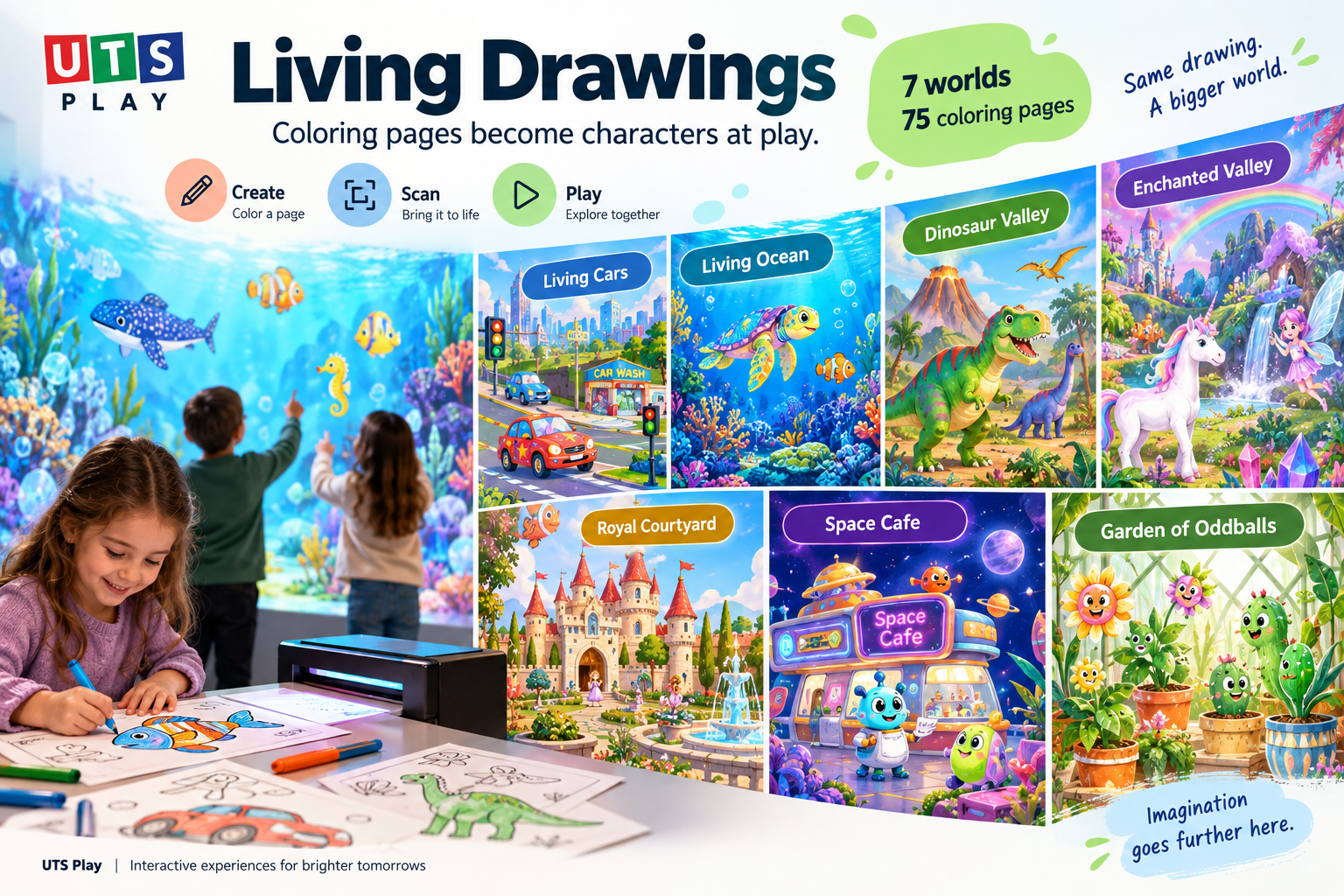
This is the idea behind Living Drawings by UTS Play, an interactive solution that connects hands-on creativity with digital play. With seven themed worlds and 75 ready-to-color pages, it offers different ways to engage children across family entertainment centers, educational institutions and interactive museums.
From Paper to an Interactive World
Living Drawings follows a simple three-step process:
Create. Children select a coloring page and bring a character to life using their own choice of colors.
Scan. A scanner recognizes the completed drawing and transfers it into the selected digital environment.
Play. The character appears on an interactive wall, where it moves and responds to touch.
The important part is that children recognize their own work in the digital world. Their color choices become part of the character they see on the screen.
The experience also continues after scanning. Children can explore their surroundings, interact with different objects and discover what happens when they touch elements of the scene.
This combination of physical and digital activities creates opportunities for creativity, observation, storytelling and shared play.
Seven Interactive Worlds, Different Ways to Explore
Living Drawings includes seven themed environments, each with its own characters, visual setting and interactive features.
Living Ocean: Discover Underwater Life
Children color fish and other sea creatures before watching them swim through a colorful underwater environment.
The interactive scene includes coral reefs, a treasure chest, a clam and bubbles. Children can touch different objects and explore their reactions. Touching a fish also opens a card with interesting facts about the creature.
For educational institutions and science museums, this world offers a starting point for conversations about marine life, animal diversity and underwater environments.
Dinosaur Valley: Explore a Prehistoric World
In Dinosaur Valley, children's colorful dinosaurs appear in a prehistoric landscape featuring a volcano, plants, a nest and a pond.
The dinosaurs move and respond to interaction, while information cards introduce their size, diet and the periods in which they lived.
Teachers and museum educators can use the experience to introduce prehistoric animals, encourage observation and ask children to compare different dinosaur species.
Children can even activate a volcanic eruption with a touch, adding an element of discovery to the experience.
Living Cars: Create a Busy City
Children design their own vehicles and watch them travel along the roads of an animated city.
Traffic lights, a car wash and a turbo boost provide additional interactive elements. Vehicles have individual sounds and movements, making the environment feel active and playful.
This world is particularly suitable for younger children and family entertainment venues. Educators can also build simple activities around transportation, traffic rules, colors and everyday city life.
Enchanted Valley: Bring Imagination into Play
Fairies, unicorns and other fantasy characters inhabit a colorful magical landscape.
Children can explore interactive portals, crystals, mushrooms and plants while watching their individually colored characters move through the environment.
The setting creates opportunities for imaginative storytelling, character descriptions and creative group activities.
Royal Courtyard: Build a Fairy-Tale Adventure
A castle courtyard becomes home to princes, princesses, knights, animals and magical characters designed by children.
The environment includes interactive elements such as a fountain, flowers and a treasure chest that opens when touched.
This world can support fairy-tale activities, role-playing scenarios and creative workshops where children invent stories around their characters.
Space Cafe: An Unusual Cosmic Adventure
Space Cafe introduces an imaginative universe filled with unusual vehicles and visitors.
Children create colorful space characters and vehicles, then interact with a cosmic cafe where visitors can receive different combinations of food and drinks.
The playful setting encourages children to make choices, experiment with combinations and invent their own space adventures.
Garden of Oddballs: A Greenhouse Full of Personality
In this cheerful greenhouse, children color imaginative plants and their pots before watching the plants dance to music.
The interactive environment includes watering actions, touch responses and a wind spinner. Ten music tracks create different moods for the dancing plants.
The world is especially suitable for creative activities combining colors, movement and music. It can also introduce younger children to simple conversations about plants and caring for them.
How Family Entertainment Centers Can Use Living Drawings
For family entertainment centers, keeping children engaged means offering activities that feel personal, varied and enjoyable.
Living Drawings can become a dedicated creative play zone or part of a larger entertainment program.
Themed activity days. A center can organize an underwater adventure one day and a dinosaur-themed experience the next. Seven available worlds provide opportunities to vary the program without changing the basic activity format.
Birthday parties. Guests can color their own characters and watch them appear together in a shared digital environment. The activity can become part of a birthday program, combining individual creativity with a collective experience.
Family activities. Parents can help younger children select colors, create characters and explore the interactive world together. This gives families a shared activity rather than separate experiences for adults and children.
Creative play between other attractions. The coloring process provides a different type of activity within an entertainment center. Children can spend time creating something with their hands before moving into interactive digital play.
The main advantage is flexibility. The same concept can support different themes, group activities and visitor interests.
Bringing Interactive Creativity into Schools and Kindergartens
In educational environments, Living Drawings can connect familiar classroom activities with interactive exploration.
Coloring is already a common activity in early childhood education. Adding a digital environment creates an opportunity to extend that activity through observation, discussion and interaction.
For example, a teacher can organize a lesson about marine animals using Living Ocean.
Children first select and color different sea creatures. After scanning, they observe their characters swimming in the underwater world. The teacher can then ask questions: Which animals look similar? How are they different? What do we know about where they live?
With Dinosaur Valley, children can explore prehistoric animals and compare their characteristics. Garden of Oddballs can support creative sessions involving plants, colors, music and movement.
Living Drawings can also be incorporated into storytelling activities. Children might describe their characters, invent adventures or work together to create a story around the shared scene.
For younger children, the experience can remain simple: choose colors, recognize a character and observe what happens when they touch the screen.
For older children, educators can introduce more detailed questions, comparisons and creative tasks.
The technology does not replace the teacher's role. Instead, it provides another visual and interactive resource that educators can incorporate into their activities.
A New Interactive Experience for Children's Museums and Science Centers
Children's museums and science centers increasingly combine physical activities with digital experiences to make exhibits more participatory.
Living Drawings offers a way to involve visitors directly in the content they explore.
Rather than simply watching an animated scene, children contribute their own colored characters to it.
This approach can be particularly useful in discovery areas and creative learning zones.
Marine life activities. Living Ocean allows visitors to interact with sea creatures and access information cards, creating opportunities to combine creative work with basic scientific facts.
Prehistoric discovery. Dinosaur Valley brings together animated dinosaurs, an interactive volcano and information about different species. Museum educators can connect the experience with broader exhibits about prehistoric life.
Creative exploration zones. Fantasy environments such as Enchanted Valley and Royal Courtyard can complement activities focused on storytelling, art and imagination.
Family workshops. Parents and children can create characters together, observe their behavior and discuss what they discover.
For museums, the value lies in connecting participation with exploration. Visitors do not only receive information; they also contribute something of their own to the experience.
Designed for Different Activities and Visitor Groups
Living Drawings includes 75 ready-to-color pages across its seven interactive worlds.
Venue teams can select a theme, preview coloring pages and print the required number of copies for an activity. The scanner recognizes the drawings and transfers them into the corresponding environment.
An updated scanning system also includes eight color correction profiles, allowing operators to adjust how colors appear on screen while preserving the drawing's original lines and shape.
These settings help venues adapt the visual result to different materials and coloring styles.
The operator can prepare the selected world and coloring pages before an activity, making the system suitable for planned sessions as well as creative play programs.
From Individual Creativity to Shared Experiences
One of the most interesting aspects of Living Drawings is the transition from individual creation to a shared interactive environment.
Every child starts with a personal drawing. Each character reflects different choices, colors and ideas. Once the drawings appear on the interactive wall, they become part of a larger scene that children can explore together.
For entertainment centers, this creates opportunities for themed attractions and family activities.
For schools and kindergartens, it connects art with discussion, observation and imaginative learning.
For children's museums and science centers, it adds a participatory element to creative and educational experiences.
Living Drawings by UTS Play brings children's artwork beyond the page, turning simple coloring activities into interactive worlds filled with movement, discovery and imagination.
Explore Living Drawings and discover how its seven interactive worlds can become part of your venue's next creative experience.