


How MINA Museum Uses UTS Interactive Equipment to Create an Immersive Learning Space for Children
August 7, 2026
August 16, 2026 at 11:01 AM
Discover how MINA Museum uses UTS iSandBOX and Astro Blaster to create an immersive educational space where children learn through play and interaction.

How MINA Museum Uses UTS Interactive Equipment to Create an Immersive Learning Space for Children
Interactive technology is increasingly becoming part of the visitor experience in children’s museums, science centers, and educational attractions. Instead of simply observing an exhibition, young visitors can experiment, move, create, and immediately see how the environment responds to their actions.
MINA Museum demonstrates how this approach can work on a large scale. Its dedicated children’s space, MINA Kids – Explorarium: A Digital Educational Journey, combines more than 15 interactive installations with educational activities focused on creativity, movement, exploration, and learning through play.
Among the interactive solutions used at MINA Kids are UTS products, including iSandBOX and Astro Blaster, which help transform traditional museum spaces into responsive digital environments where children become active participants in the experience.
MINA Kids: A 1,000 m² Interactive Environment
MINA Kids was created as a dedicated immersive space for children aged approximately 3 to 10 years.
The 1,000-square-meter area brings together digital installations and physical activities designed to support different types of learning and play. Children can explore topics connected with nature and healthy lifestyles, create their own digital characters, interact with projected environments, and participate in activities that encourage physical movement.
Rather than building the experience around a single attraction, MINA Kids uses a combination of technologies to create different activity zones. This gives families more reasons to move through the space, try new experiences, and spend more time exploring.
For museums and science centers, this multi-activity model is particularly valuable because it makes it possible to address different interests and age groups within the same visitor journey.
UTS iSandBOX: Turning Sand into an Interactive Landscape
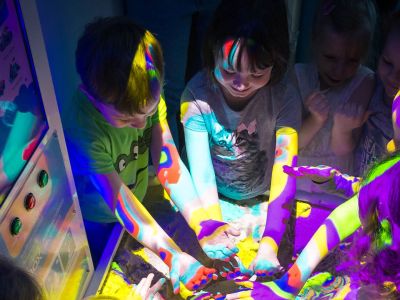
One of the UTS installations presented at MINA Kids is iSandBOX, an augmented reality sandbox that combines real sand with projection and real-time motion tracking.
Children can physically reshape the sand to create mountains, valleys, slopes, and other forms. The projected digital environment reacts immediately to these changes, transforming the surface according to the terrain created by the participants.
Water can flow through valleys, landscapes can change as the sand is moved, and children can see a direct connection between their physical actions and what happens in the digital environment.
For a museum setting, this creates an important transition from passive observation to experimentation.
A child does not simply look at a representation of a landscape. They build it.
They can change the terrain, observe the result, modify it again, and discover through experience how different elements of a landscape relate to one another.
Learning Through Experimentation
The educational potential of an interactive sandbox comes from this continuous cycle of action and response.
Children can intuitively explore concepts connected with:
terrain and topography;
mountains and valleys;
water movement;
spatial relationships;
cause and effect;
environmental processes.
The experience does not have to feel like a formal lesson. The educational component is embedded directly into play.
This is particularly relevant for museums and science centers working with younger visitors, for whom physical experimentation can make complex or abstract concepts significantly easier to understand.
The same installation can also support both free exploration and structured educational activities led by museum educators.
Astro Blaster: Making Museum Walls Interactive
MINA Kids also uses Astro Blaster by UTS, another example of how digital technology can activate an existing museum surface.
Instead of functioning as an ordinary wall, the projection becomes an interactive gaming environment. Children participate physically, respond to objects and events appearing on the screen, and become part of the digital experience.
This type of attraction adds an important movement-based component to the museum visit.
For children, it provides an opportunity to switch between quieter exploratory activities and more active play. For museums, it makes it possible to create an engaging attraction without relying only on physical exhibits or large mechanical structures.
The result is a space in which the architecture itself becomes part of the experience.
Combining Physical and Digital Play
One of the most interesting aspects of the MINA Kids concept is that digital technology does not replace physical activity.
It enhances it.
With iSandBOX, children touch and reshape real sand.
With interactive wall experiences such as Astro Blaster, they move and interact physically with projected content.
Other installations at MINA Kids follow a similar principle. For example, children can color objects on paper and then see their creations appear within a digital environment.
This combination of tangible objects, movement, projection, and responsive digital content is particularly suitable for younger audiences because interaction remains intuitive. Children do not need to learn complicated controls or navigate traditional computer interfaces before they can participate.
They can simply start playing.
Why Interactive Installations Work in Children’s Museums
Children’s museums and science centers face a particular challenge: exhibits need to communicate ideas while also maintaining the attention of visitors who often expect a high level of interaction.
Immersive technologies can help bridge this gap.
They turn the visitor from an observer into a participant and allow the same environment to support several objectives at once: education, entertainment, movement, experimentation, and social interaction.
An interactive installation can also be approached differently by different children. One visitor may concentrate on completing a task, another may experiment freely, while several children can collaborate or play together.
This flexibility is useful for museums serving families, school groups, and visitors of different ages.
Creating Experiences Visitors Can Remember
Digital installations also contribute to the overall perception of a museum.
Large projections, responsive environments, and unexpected combinations of physical and digital objects create moments that are visually distinctive and easy for visitors to remember.
For a museum, this can help turn an educational visit into an experience families want to discuss, photograph, and potentially repeat.
The goal is not simply to add screens to an exhibition. The more effective approach is to create interactions in which technology responds naturally to the visitor.
MINA Kids illustrates this principle particularly well: children shape landscapes, create digital content, move through interactive environments, and influence what they see around them.
A Practical Model for Modern Educational Attractions
The MINA Museum case shows how UTS interactive equipment can become part of a broader museum concept rather than function as an isolated entertainment attraction.
iSandBOX and Astro Blaster integrate physical activity, digital content, and immediate visual feedback into the visitor journey, complementing other educational and creative installations across MINA Kids.
For children’s museums, science centers, discovery centers, and other educational venues, this approach offers a practical way to create environments where visitors learn through action.
Instead of asking children only to look, read, or listen, interactive technology gives them something to change, test, build, and explore.
And that is precisely what makes spaces such as MINA Kids different from a conventional exhibition: children are not simply visiting the experience.
They are helping create it.