


One Lesson, Several Ways to Engage Children: Combining Teacher Explanation, Interactive Play and Discussion
October 5, 2026
October 7, 2026 at 11:16 AM
Discover how teachers can combine explanation, interactive play and discussion in one lesson to engage children and support active learning.

One Lesson, Several Ways to Engage Children: Combining Teacher Explanation, Interactive Play and Discussion
Children do not all learn in the same way. Some understand a new idea when they hear a clear explanation. Others need to see it. Some need to touch, move, experiment or try something themselves before the idea becomes clear.
For schools and kindergartens, this means that engagement does not have to depend on a single teaching method. A lesson can combine several formats within the same activity: teacher explanation, interactive play, practical experimentation and group discussion.
Interactive equipment can help connect these formats and turn a lesson into a sequence in which children first receive information, then work with it and finally discuss what they have discovered.
Start with the teacher
Technology does not have to be the starting point of an interactive lesson.
The teacher can begin in a familiar way: introduce a topic, ask a question, show an example or explain a new concept. This first stage gives children the context they need before moving to practical activity.
For example, during a geography lesson, the teacher can introduce mountains, valleys, rivers and lakes and explain how the shape of the land influences the movement of water.
For younger children, the introduction can be simpler: Where does water go when it rains? Can water flow uphill? What happens if we build a mountain?
The important point is that children already have a question in mind before they start interacting with the equipment.
Move from explanation to action
The next stage allows children to explore the same idea through their own actions.
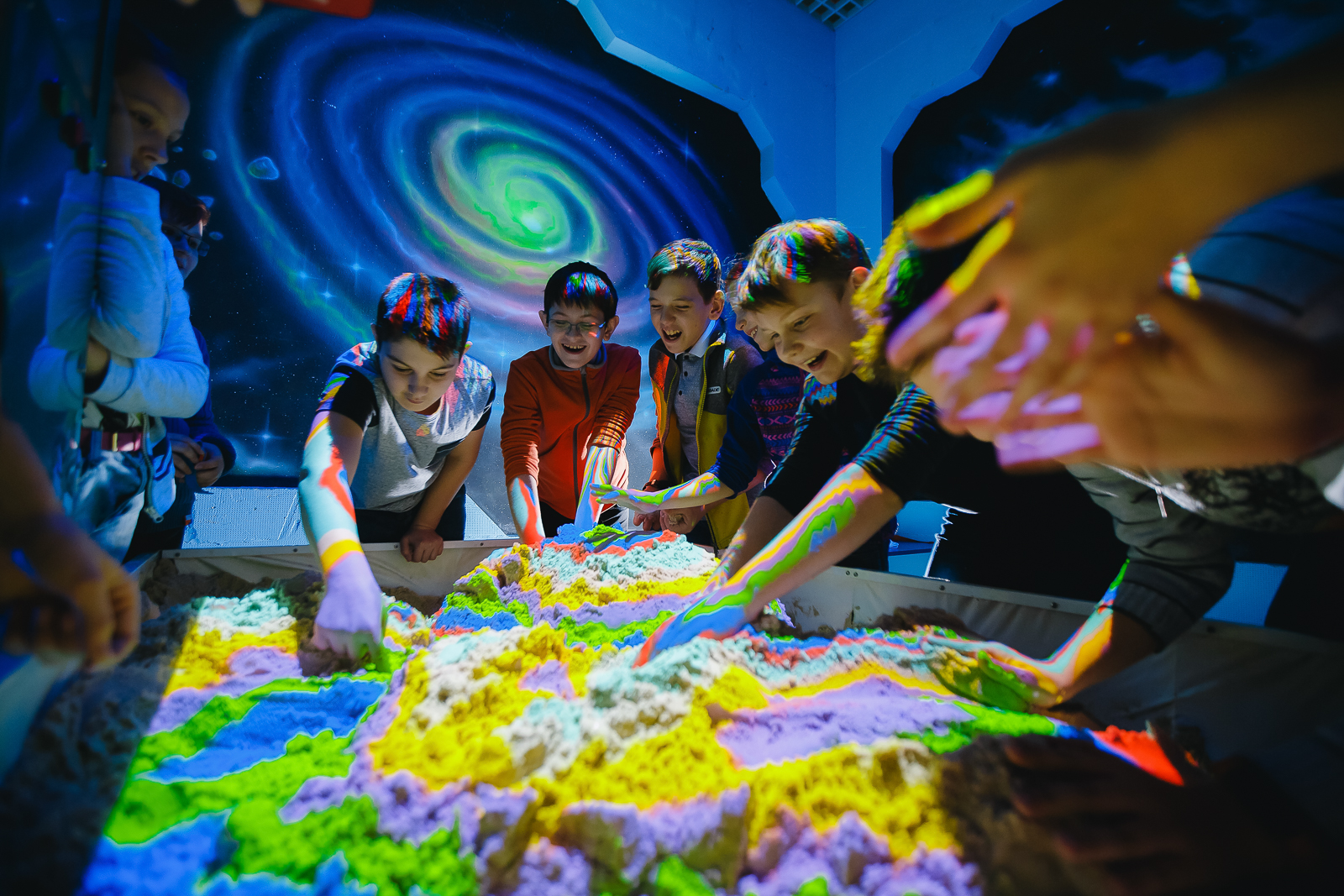
With iSandBOX, for example, children can reshape real sand to create mountains, valleys and plains. The interactive visualization changes together with the physical landscape, allowing children to immediately see the result of what they have created.
Instead of only hearing that water flows from higher to lower areas, children can build a landscape and observe what happens. They can change the shape of a slope, create a barrier or dig a new channel and compare the results.
The lesson therefore moves from “the teacher explained it” to “we tried it ourselves.”
This transition is important because the interactive activity is directly connected to the subject being taught. It is not a separate game added simply to entertain the class.
Give children different roles
Interactive activities can also involve children who may participate less actively during a traditional explanation.
Not every child has to perform the same task at the same time. One child can change the landscape, another can observe what happens, while others predict the result or explain what they notice.
The teacher can rotate these roles throughout the lesson.
For example, before changing the landscape, one group can answer the question: “Where do you think the water will go?”
Another group can make the change.
A third group can observe the result and decide whether the original prediction was correct.
This creates several ways to participate in the same learning process.
Stop the game and talk
One of the most useful moments in an interactive lesson can happen when the interaction stops.
After an experiment or game, the teacher can bring the children back together and ask them to explain what happened.
Why did the water move in this direction?
What changed when we made the mountain higher?
Why did our first idea not work?
What could we change next?
Discussion helps children connect an experience with the concept behind it. They are not only remembering what they saw on the interactive surface; they are learning to describe relationships, compare results and explain their reasoning.
For younger children, even simple questions such as “What happened?”, “Why?” and “What should we try next?” can turn play into a structured learning activity.
Try the idea again
A lesson does not have to end after the discussion.
Children can return to the interactive activity with a new task based on what they have just learned.
The teacher might say: “Now build a landscape where the water reaches this point without passing through this area.”
The class now has to apply its previous observations to solve a new problem.
This creates a simple learning cycle:
Explanation → prediction → interactive activity → observation → discussion → new attempt
The same structure can be adapted to different ages, subjects and learning objectives.
One activity can involve different types of learners
Combining several formats within one lesson can also make participation more flexible.
Children who are comfortable speaking can contribute during discussion. Children who prefer practical activities can take part in experiments. Visual learners can follow changes on the interactive surface. Children who need more time to formulate an answer can first observe what happens and then discuss it with classmates.
The purpose is not to divide children into fixed “learning styles,” but to give the whole group more than one way to approach the same concept.
A child who did not fully understand an explanation may understand the idea after seeing it in action. Another child may understand the activity itself but only recognize the underlying principle after discussing it with the teacher.
The teacher remains at the center of the lesson
Interactive technology is most useful when it supports a clear educational objective.
The equipment does not need to take over the entire lesson, and the teacher does not become an observer while children play independently.
Instead, the teacher controls the sequence: introduces the question, defines the task, asks children to make predictions, guides the activity and helps them interpret the result.
This makes interactive equipment a teaching tool rather than simply an additional source of entertainment.
A flexible format for schools and kindergartens
The same approach can work differently depending on the age of the children.
In kindergarten, a lesson may consist of a short explanation, a simple interactive task and a conversation about what children noticed.
In primary school, teachers can add predictions, team roles and comparisons between different results.
With older children, the activity can become a structured experiment: formulate a hypothesis, change one condition, observe the result and explain why it happened.
The technology remains the same, while the complexity of the task changes with the group.
From listening to exploring and explaining
A lesson does not have to choose between teacher-led instruction and interactive learning.
The two approaches can reinforce each other.
The teacher provides context and direction. Interactive play gives children an opportunity to act on the information. Observation makes the result visible. Discussion helps turn that experience into understanding.
With interactive solutions from UTS Play, schools and kindergartens can create lessons in which children do more than listen or watch. They can predict, experiment, discuss, reconsider and try again — while the teacher remains in control of the learning process.
This makes one lesson more varied without losing its educational structure and gives more children an opportunity to become active participants in learning.