


One Space, Different Play Scenarios with FlexPlay
September 11, 2026
September 14, 2026 at 04:43 PM
Discover how FlexPlay helps family entertainment centers use one space for different play scenarios, from creative activities to active and competitive games.

One Space, Different Play Scenarios: How FlexPlay Keeps an Entertainment Zone Changing Throughout the Day
For a family entertainment center, every square meter has to work hard. A play zone that attracts one age group but stays empty when the audience changes during the day is not using its full potential.
But creating a separate attraction for younger children, another one for active group games and another for teenagers requires more space, more equipment and more investment.
A different approach is to make the space itself flexible.
With UTS FlexPlay, one prepared play zone can support different types of interactive experiences. Instead of assigning the area to one fixed activity, an entertainment center can use it for creative play, movement, competition and group entertainment at different times.
The Audience Changes Throughout the Day. Why Should the Attraction Stay the Same?
The visitor mix in a family entertainment center is rarely constant.
A weekday morning may bring younger children and parents. Later, an organized group may arrive. Afternoons can become busier with families, while birthdays, teenagers and larger groups may dominate evenings and weekends.
Each audience expects something different.
Younger children may prefer colorful activities with simple interactions. Families may want experiences where children can create something of their own. Older children often respond better to faster games, challenges and competition. Birthday groups need activities that several participants can enjoy together.
A fixed attraction has to serve all of them in exactly the same way.
A flexible attraction can change with them.
Six Ways to Use an Interactive Play Space
FlexPlay is built around a modular technology platform that can support six different attraction formats:
Ball vs. Wall — active games where players throw soft balls at projected targets.
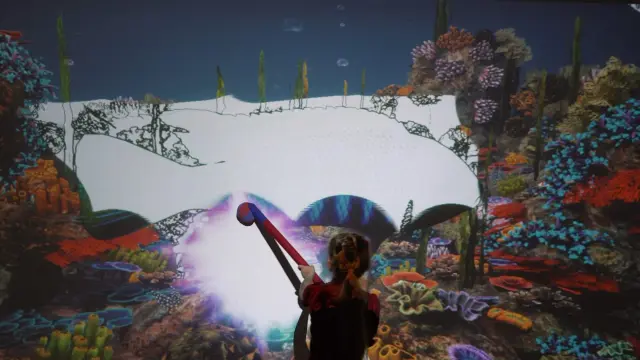
Paints & Brushes — creative activities where children interact with projected scenes using physical brushes.
Living Drawings — children color characters on paper, scan them and see their creations appear in an animated digital environment.
Astro Blaster — laser-based competitive and cooperative games.
Jumper — movement-based games controlled through jumping, squatting and full-body actions.
Floorium — an interactive floor that responds to movement, steps and gestures.
The important point for an entertainment center is not simply that several games are available. These formats create fundamentally different types of visitor activity.
The same zone can support quiet creative play, energetic physical activity, collaborative experiences or competition depending on its installed configuration.
One Zone Can Have Several Roles During the Day
Imagine a FlexPlay zone inside a family entertainment center.
In the morning, when the venue is quieter and younger children are visiting with their parents, the operator could focus on creative experiences. Paints & Brushes allows children to interact with projected scenes physically, while Living Drawings turns their own pictures into part of an animated world.
Later, when larger groups arrive, the same area can shift toward more active group entertainment. Ball vs. Wall introduces movement, coordination and a clear shared objective.
For a scheduled birthday or group event, the operator can choose games that encourage teams, scoring or friendly competition.
During periods when older children and teenagers are more common, competitive experiences such as Astro Blaster can give the zone a very different character.
Where the appropriate FlexPlay configuration is installed, Floorium or Jumper can add another type of physical interaction and create a stronger movement-focused experience.
The room has not changed.
What visitors are doing inside it has.
A Possible Daily Rotation
There is no universal schedule for every entertainment center. The right rotation depends on visitor age, peak periods, group bookings and the specific FlexPlay formats installed at the venue.
A typical day could, for example, be structured like this:
Morning: creative play
Start with slower, intuitive activities for younger visitors and families. Creative formats make it easy for children to join without needing to understand complex rules.
Early afternoon: open group play
As visitor numbers increase, switch the focus toward activities that allow several children to participate and make the zone visually active.
Afternoon: active challenges
Introduce faster games using balls, movement or other physical interaction to match the higher energy level of the venue.
Birthday booking: team competition
Use games with clear objectives, scores or team challenges to turn the same area into part of a structured birthday program.
Evening: competitive play
For older children and teenagers, move toward skill-based and competitive experiences that encourage players to try again and improve their result.
Instead of expecting one attraction to generate the same level of interest from opening to closing, the entertainment center can match the experience to the people actually using the venue.
More Variety Without Building Another Room
For entertainment operators, adding variety often means adding equipment.
That can quickly become a problem when floor space is limited.
A new attraction may require its own dedicated area, safety zone, installation and operating procedures. Once installed, that space may remain tied to the same type of experience for years.
FlexPlay follows a different model.
Its shared projection, computing and tracking infrastructure forms the basis of the play zone, while different format kits determine how visitors interact with it.
Some formats can share the same wall installation and change through software and accessories. Other expansions — such as laser interaction, trampoline-based play or an interactive floor — require additional equipment or calibration.
This modular approach means an entertainment center can plan the space around several possible experiences rather than one permanent use.
Different Audiences, Same Investment in Space
This flexibility is especially relevant for family entertainment centers because their audience is naturally mixed.
A venue does not serve only five-year-olds or only teenagers. Parents may arrive with children of different ages. Birthday groups can include both confident players and younger participants. Weekday and weekend audiences can look completely different.
A flexible interactive zone gives operators more options for responding to these changes.
Instead of asking, “Which audience is this attraction for?” the question becomes:
“Which experience should we run for the audience that is here now?”
That is a fundamentally different way to think about entertainment space.
Rotation Also Helps Keep the Experience Fresh
Changing scenarios is useful not only within a single day.
It can also help over weeks and months.
Visitors who have already played one game do not necessarily need a completely new attraction to discover something different on their next visit. Operators can rotate games within a format and, where their configuration allows it, introduce another interaction format later.
For repeat visitors, the physical location may be familiar, but the experience does not have to be identical.
That creates another reason to return — without requiring the entertainment center to rebuild the zone every time it wants to refresh its offer.
Plan the Space Around Experiences, Not Just Equipment
The most useful question when designing a family entertainment center is not always “How many attractions can we fit here?”
It can be more valuable to ask:
Who uses this area in the morning, afternoon and evening?
Which age groups need to be served?
How often do we host birthdays or organized groups?
Where do we need active play, and where do we need calmer activities?
How can the experience change without adding another dedicated attraction?
FlexPlay provides one way to approach these questions.
With several interactive formats built around a modular platform, one prepared space can take on different roles as the audience changes.
For an entertainment center, that means the same square meters can become a creative zone, an active challenge, a group activity or a competitive attraction at different points in the visitor journey.
One space does not have to mean one experience.